White Pillar on Jabal al-Rahmah
Mecca, Saudi Arabia

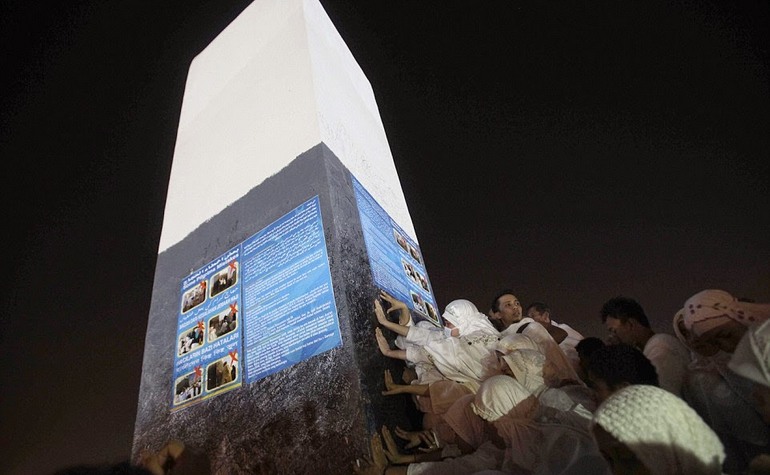
Discover the White Pillar on Jabal al-Rahmah, Mount Arafat, Mecca, Saudi Arabia – a site of profound Hajj significance and history.
<h2>Overview</h2><p>Nestled within the vast plains of Mount Arafat, approximately 20 kilometers southeast of Mecca in Saudi Arabia, stands the White Pillar on Jabal al-Rahmah. Known also as the 'Mount of Mercy', Jabal al-Rahmah is a significant granite hill, and the pillar atop it serves as a powerful symbol for millions of Muslims worldwide. While the entire plain of Arafat holds immense spiritual weight, this particular spot, marked by the white pillar, carries profound historical and religious significance, drawing pilgrims to its elevated summit during the annual Hajj pilgrimage. It is here, amidst the solemn gathering of humanity, that moments of immense spiritual reflection and supplication unfold, connecting present-day pilgrims to the foundational events of Islamic history.</p><p>The White Pillar itself is a visible marker, often described as a seven-meter-high structure, with some accounts detailing a blue base and white topping. Its presence helps guide the throngs of pilgrims to a location steeped in the spiritual narrative of Islam, offering a focal point for their devotions during one of the most critical rites of the Hajj.</p><h2>History & Cultural Background</h2><p>The White Pillar on Jabal al-Rahmah marks a site central to two pivotal narratives in Islamic tradition. Foremost among them is the location where Prophet Muhammad (peace be upon him) delivered his momentous Farewell Sermon (Khutbat al-Wada) to thousands of his companions during his final Hajj pilgrimage in 632 CE. This sermon, delivered on the 9th of Dhul Hijjah, provided comprehensive guidance on the principles of Islam, emphasizing human equality, the sanctity of life and property, the rights of women, and adherence to the Quran and Sunnah. A defining moment during this address was the revelation of the Quranic verse: 'This day I have perfected for you your religion and completed My favour upon you and have approved for you Islam as religion' (Quran 5:3), signifying the completion of Allah's message to mankind.</p><p>Adding another layer of historical depth, some Islamic traditions hold that Jabal al-Rahmah is the very place where Prophet Adam and Hawa (Eve) reunited on Earth after their descent from Paradise. It is believed to be the spot where Adam's repentance was accepted by Allah, leading to the mountain's designation as the 'Mount of Mercy'. These profound historical connections imbue the White Pillar and its surroundings with an unparalleled spiritual resonance, making it a place of immense emotional and religious significance for Muslims.</p><h2>What Makes It Special</h2><p>The White Pillar on Jabal al-Rahmah is special because it embodies the spiritual climax of the Hajj pilgrimage: the Wuquf Arafah, or 'standing on Arafat'. On the 9th day of Dhul Hijjah, pilgrims gather on the plains and slopes of Mount Arafat, from noon until sunset, engaging in fervent prayer, supplication (dua), and seeking forgiveness from Allah. This day is considered the essence of Hajj, as Prophet Muhammad (PBUH) stated, 'Hajj is Arafat.' The presence of the White Pillar acts as a poignant reminder of these foundational events and the immense mercy and forgiveness that are believed to be bestowed upon sincere devotees at this sacred location. The collective spiritual energy of millions of pilgrims, united in purpose and devotion, transforms the area into an unparalleled landscape of faith and hope. For those unable to perform Hajj, the Day of Arafah is still a highly virtuous day, with fasting recommended as a means of expiating sins for the past and coming year.</p><h2>Stories, Fun Facts & Local Details</h2><p>Beyond its solemn significance, Jabal al-Rahmah and its White Pillar are rich with stories and local insights. One popular tradition suggests that the name 'Arafat' itself, derived from the Arabic root 'arafa' meaning 'to know', relates to Adam and Hawa 'knowing' or recognizing each other after their long separation. The mount has also been known by other names, including 'al-Qurain' and 'al-Duaa' (supplication), highlighting its role as a place of intense prayer. While pilgrims strive to reach Jabal al-Rahmah, it's a common misconception that one must physically stand *on* the mountaintop. Islamic teachings clarify that the entire plain of Arafat is considered a valid place for the Wuquf, emphasizing the spiritual state over the exact physical location.</p><p>Interestingly, the pillar itself is a more recent addition, not present during the Prophet's time. Its primary function is to serve as a recognizable landmark for the millions of pilgrims. However, due to its prominence, some pilgrims mistakenly treat the pillar as an object of veneration, touching or kissing it, a practice discouraged by Islamic authorities to prevent any form of idolatry. Security personnel are often present to gently guide pilgrims, reminding them that the focus should remain on prayer and reflection directed solely towards Allah. The Day of Arafah is also known for being a day when Allah frees more people from Hellfire than any other day, making the supplications offered here particularly potent.</p><h2>Visitor Perspective</h2><p>For pilgrims undertaking the Hajj, the journey to the White Pillar on Jabal al-Rahmah is a deeply emotional and transformative experience. As dawn breaks on the 9th of Dhul Hijjah, countless individuals clad in simple white ihram garments make their way to Mount Arafat. The atmosphere is one of profound humility, anticipation, and collective devotion. Climbing the gentle slopes of Jabal al-Rahmah towards the White Pillar, pilgrims engage in heartfelt supplications, seeking forgiveness for their sins and praying for blessings for themselves and their loved ones. Many spend hours in quiet contemplation, reading the Quran, and reflecting on the teachings of the Farewell Sermon. The sheer number of people, all unified in their spiritual quest, creates an overwhelming sense of solidarity and connection to the vast history of Islam. The sight of millions of hands raised in prayer, often accompanied by tears of repentance and hope, is a powerful testament to the spiritual significance of this place. Despite the crowds, many describe finding an intense personal connection with their Creator, experiencing a profound sense of peace, mercy, and renewal at this sacred site.</p>
Location
Coordinates: 39.9841, 21.3549
View on Google Maps