Phra Ubosot
Bangkok, Thailand

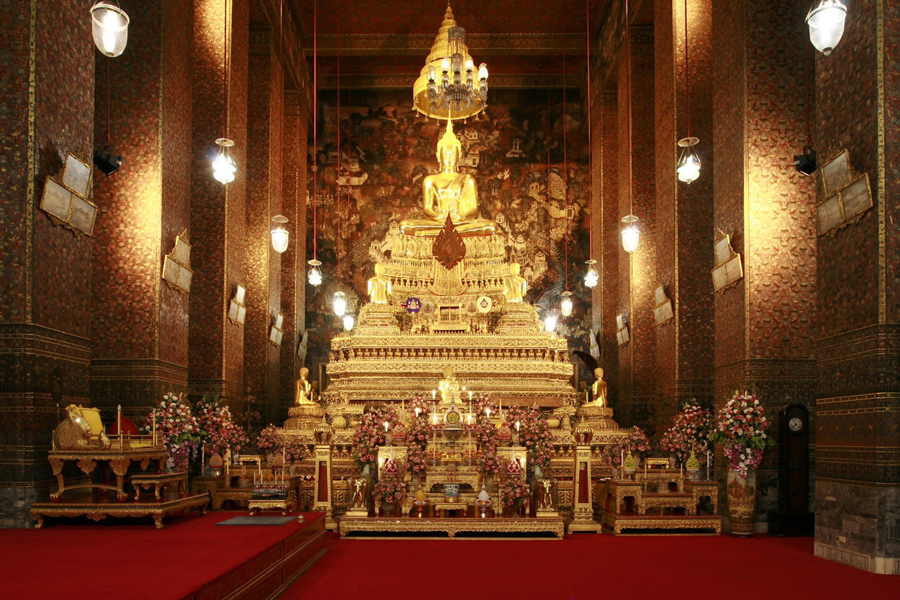
Explore Phra Ubosot, the sacred ordination hall within Wat Pho in Bangkok, Thailand. Discover its rich history, stunning architecture, and cultural significance.
<h2>Overview</h2><p>Stepping into the tranquil grounds of Wat Pho in Bangkok, Thailand, one of the most revered and ancient Buddhist temple complexes, you'll find its spiritual heart beating within the Phra Ubosot. Often referred to as the ordination hall, this sacred structure is not just a building; it's a profound encapsulation of Thai artistry, faith, and royal heritage. It serves as the principal hall where Buddhist monastic rituals are performed, making it the most hallowed space within the sprawling Wat Pho compound. While many visitors flock to Wat Pho for the awe-inspiring Reclining Buddha, the Phra Ubosot offers a quieter, yet equally enriching, experience, inviting contemplation and admiration for its exquisite details and deep cultural significance.</p><h2>History & Cultural Background</h2><p>The story of the Phra Ubosot is deeply intertwined with the foundation and evolution of Bangkok itself. Its initial construction dates back to the reign of King Rama I, the founder of the Chakri Dynasty and the establisher of Bangkok as the capital. Built in the graceful Ayutthaya style, the ordination hall was dedicated in 1791, even before the complete rebuilding of Wat Pho was finalized. This act underscored its immediate importance as the spiritual core of the newly established royal temple.</p><p>Later, during the reign of King Rama III (1824–1851), the Phra Ubosot underwent significant enlargement and reconstruction, adopting elements of the Rattanakosin style that defined much of the temple's current appearance. This period of extensive renovation aimed to transform Wat Pho into a center of public education and knowledge, with the Phra Ubosot remaining its ceremonial heart. It's a place where the legacies of two powerful kings converge, as some of the ashes of King Rama I are reverently enshrined beneath the pedestal of the principal Buddha image within the hall, allowing visitors to pay homage to both the monarch and the Buddha simultaneously.</p><h2>What Makes It Special</h2><p>The Phra Ubosot's special allure lies in its meticulous design and the sacred artifacts it houses. The hall stands proudly on a raised marble platform, a detail that immediately conveys its importance. Its teak doors are a masterpiece of craftsmanship; the outer panels are exquisitely inlaid with mother-of-pearl, depicting intricate scenes from the Ramayana, the Thai epic known as Ramakian. On the inner side, the panels feature painted specimens of ecclesiastical fans of rank, symbolizing the hierarchy within the monastic order.</p><p>Inside, the focal point is the gilded Buddha image, Phra Buddha Theva Patimakorn, seated majestically on a three-tiered pedestal. Above this revered statue, a nine-tiered umbrella signifies the authority of Thailand and the revered status of the Buddha. The walls are adorned with impressive murals that illustrate various Buddhist narratives, including the Mahosatha Pandita, depictions of the heavens, and the disciple Phra Etadagga. The surrounding double cloister, Phra Rabiang, adds another layer of beauty, housing approximately 400 Buddha images, some of which are historical pieces from different eras of Thailand's past.</p><h2>Stories, Fun Facts & Local Details</h2><p>Beyond its formal religious function, the Phra Ubosot and its immediate surroundings tell a richer story. Encircling the ordination hall is a low marble wall featuring 152 bas-reliefs. These detailed carvings narrate tales from the Ramakian, offering a pictorial encyclopedia of ancient Thai literature and belief. Observing these reliefs provides a glimpse into the cultural imagination and storytelling traditions that have shaped Thai identity for centuries.</p><p>Wat Pho is also famously known as Thailand's first public university, a legacy initiated by King Rama III. While the Phra Ubosot is primarily for spiritual rites, the broader temple complex, including areas near the Ubosot, was designed to disseminate knowledge. Granite slabs inscribed with subjects like history, medicine, and proverbs were placed around the temple for public learning, transforming the entire space into a living library. This educational mission makes the Phra Ubosot part of a larger institution that valued both spiritual enlightenment and intellectual growth.</p><h2>Visitor Perspective</h2><p>Visiting the Phra Ubosot offers a deeply immersive cultural experience. As with all sacred sites in Thailand, respect for local customs is paramount. Visitors are required to dress modestly, ensuring shoulders and knees are covered, and to remove their footwear before entering the hall. The atmosphere inside is one of serene reverence, providing a stark contrast to the bustling city outside. Observing the intricate architecture, the shimmering Buddha image, and the detailed murals allows for a quiet moment of reflection and appreciation. Though the Reclining Buddha often draws the largest crowds, taking the time to explore the Phra Ubosot offers a deeper understanding of Wat Pho's spiritual significance and artistic grandeur. It's a chance to witness living history and the enduring devotion embedded in Thai Buddhist practice.</p>
Location
Coordinates: 100.49361, 13.74639
View on Google Maps