Wat Pho
Bangkok, Thailand

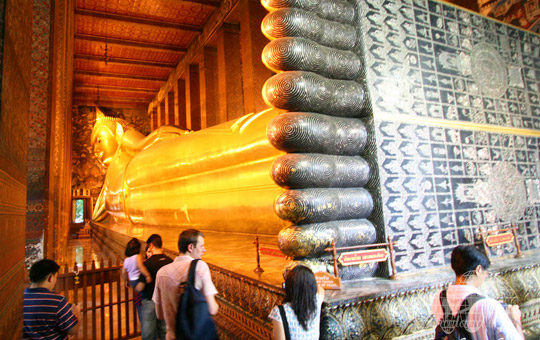
Explore Wat Pho in Bangkok, Thailand, home to the magnificent Reclining Buddha, Thailand's largest Buddha collection, and the birthplace of Thai massage. Discover its rich history and cultural significance.
<h2>Overview</h2><p>Step into the tranquil and culturally rich complex of Wat Pho, one of Bangkok, Thailand's most revered and oldest Buddhist temples. Officially known as Wat Phra Chetuphon Wimon Mangkhalaram Rajwaramahawihan, it is affectionately called 'The Temple of the Reclining Buddha' by many. This expansive royal temple offers a profound glimpse into Thai spirituality, history, and traditional arts. Located just south of the Grand Palace, Wat Pho is a must-visit destination that encapsulates centuries of Thai heritage, from its iconic colossal statue to its role as a birthplace of traditional Thai massage.</p><h2>History & Cultural Background</h2><p>Wat Pho holds a history that predates Bangkok itself, with its origins stretching back to the 17th century during the Ayutthaya period. Initially named Wat Photaram, the temple underwent significant restoration and enlargement under the patronage of King Rama I, who established Bangkok as the capital in 1782. It became his principal temple, and some of his ashes are enshrined within its sacred grounds.</p><p>Further extensive renovations and expansions were carried out by King Rama III (1824–1851). During his reign, Wat Pho transformed into Thailand's first public university. The king commissioned the engraving of knowledge across various subjects — including history, medicine, literature, and Buddhism — onto stone slabs and murals throughout the temple complex. This initiative aimed to preserve and disseminate traditional Thai wisdom to the general public, a mission that continues to this day. The name 'Pho' itself refers to the Bodhi tree, the sacred fig tree under which the Buddha attained enlightenment, emphasizing the temple's deep spiritual roots. Wat Pho's significant contribution to the preservation of cultural heritage has been recognized by UNESCO as part of its Memory of the World Programme for the Asia-Pacific region.</p><h2>What Makes It Special</h2><p>The undisputed centerpiece of Wat Pho is the awe-inspiring <strong>Reclining Buddha</strong>, a magnificent statue measuring 46 meters (151 feet) in length and 15 meters (49 feet) in height. Crafted from plaster around a brick core and sumptuously covered in gold leaf, this serene image depicts the Buddha in his final pose before entering Nirvana, a state of complete spiritual enlightenment. The Buddha's eyes and the soles of his feet are exquisitely inlaid with mother-of-pearl. The feet alone are 5 meters long and feature 108 auspicious symbols, illustrating the characteristics by which the Buddha can be identified, and incorporating both Chinese and Indian artistic styles.</p><p>Beyond the Reclining Buddha, Wat Pho is celebrated for housing the <strong>largest collection of Buddha images in Thailand</strong>, with over 1,000 statues spread throughout the complex, including 394 gilded Buddha images within its four chapels. The temple is also renowned as the <strong>birthplace of traditional Thai massage</strong>. In a mandate legislated by King Rama III to prevent the extinction of this ancient healing art, Wat Pho established a school for traditional Thai medicine and massage, which continues to operate today. Thai traditional massage was recognized as a UNESCO Intangible Cultural Heritage in 2019. Visitors can even experience an authentic Thai massage on the temple grounds.</p><p>The expansive grounds, covering approximately 80,000 square meters, are dotted with more than 99 elaborately decorated <em>chedis</em> (stupas), making it the temple with the most chedis in Thailand. You might also notice intriguing Chinese statues used as ship ballast centuries ago, now standing as guardians within the courtyards.</p><h2>Stories, Fun Facts & Local Details</h2><p>One of the most engaging rituals for visitors takes place at the hall of the Reclining Buddha. Along the wall, 108 bronze bowls are arranged, representing the 108 auspicious characteristics of the Buddha. Visitors can purchase coins and drop one into each bowl, a practice believed to bring good fortune and contribute to the upkeep of the temple.</p><p>A serene atmosphere pervades Wat Pho, offering a more tranquil experience compared to some of Bangkok's other bustling attractions. Keep an eye out for the Bodhi tree on the temple grounds, believed to be a descendant of the sacred tree under which the Buddha attained enlightenment. For a deeper cultural immersion, consider visiting around 5:00 PM, when monks often gather to chant their evening prayers in the main ordination hall.</p><h2>Visitor Perspective</h2><p>To ensure a respectful visit to Wat Pho, which remains an active place of worship, adhere to the local customs. Dress modestly, covering your shoulders and knees, and avoiding cleavage. You will be asked to remove your shoes before entering any temple buildings, so wearing comfortable, easy-to-slip-on footwear is advisable.</p><p>The temple is generally open from 8:00 AM to 7:30 PM daily, with an entrance fee of 300 Thai Baht for foreign visitors. It is recommended to arrive early in the morning or later in the afternoon to avoid the midday heat and larger crowds. Wat Pho's central location, adjacent to the Grand Palace, makes it a convenient and enriching addition to any Bangkok itinerary. While tuk-tuk drivers might offer tempting rides, be wary of those claiming the temple is closed; it is almost always open. Consider indulging in a traditional Thai massage at the famous Wat Pho Thai Traditional Medical and Massage School onsite for a truly authentic and rejuvenating experience after exploring the vast temple grounds.</p>
Location
Coordinates: 100.49361, 13.74639
View on Google Maps