Torture at the Tower
London, United Kingdom

Explore 'Torture at the Tower' in London's Tower of London, United Kingdom. Discover medieval interrogation methods and chilling prisoner stories.
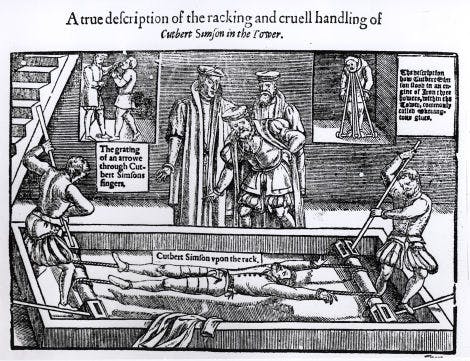
<h2>Overview</h2><p>Deep within the ancient walls of the Tower of London, a UNESCO World Heritage Site in London, United Kingdom, lies a chilling exhibition known as 'Torture at the Tower'. This permanent installation offers a visceral glimpse into a dark chapter of English history, primarily focusing on the 16th and 17th centuries when the Tower served as a notorious state prison. Far from a mere collection of macabre objects, the exhibit brings to life the stark realities faced by those accused of treason and heresy, illustrating how physical and psychological torment was employed to extract confessions and information. Visitors encounter replicas of the infamous instruments used, such as the rack, the Scavenger's Daughter, and manacles, set within the atmospheric confines of the Lower Wakefield Tower, allowing for a profound, if unsettling, connection to the past.</p><h2>History & Cultural Background</h2><p>While the Tower of London's reputation as a place of torture is widespread, it's surprising to learn that its use was largely confined to the turbulent 16th and 17th centuries, particularly during the Tudor period. This era was marked by intense political and religious upheaval, where loyalties were fiercely tested and dissent was ruthlessly suppressed. Torture was not, contrary to popular belief, used as a form of punishment under English law. Instead, it was sanctioned by the Privy Council and the monarch as an interrogation tool, a means to uncover conspiracies and identify accomplices. The objective was to break a prisoner's resolve, with the mere threat of agony often proving sufficient to compel confession.</p><p>Among the most dreaded devices were the rack, designed to stretch the victim's body until joints dislocated, and the Scavenger's Daughter, which achieved the opposite effect by compressing the body into a crouched position, forcing blood from orifices. Manacles were also employed, suspending prisoners by their wrists for prolonged periods, causing immense pain and long-term injury. Historical records highlight that only a fraction of the Tower's many prisoners endured physical torture, yet the psychological impact of imprisonment, solitary confinement, and deprivation was a constant torment for many more.</p><h2>What Makes It Special</h2><p>The 'Torture at the Tower' exhibition is unique in its ability to transport visitors directly into the harrowing experiences of the past. It's not just a display of historical artifacts; it's an immersive educational experience that contextualizes the methods of interrogation and the broader political climate of the time. The replicas, while chilling, serve as tangible representations of the brutality once sanctioned by the state. Experiencing these grim relics within the authentic environment of the Tower itself, where prisoners like Jesuit priest John Gerard and Protestant preacher Anne Askew suffered, deepens understanding and evokes a powerful sense of historical empathy.</p><p>Furthermore, the exhibit helps to clarify common misconceptions, distinguishing between the exaggerated Victorian narratives that fueled the Tower's gothic reputation and the documented historical realities of torture. It underscores that while physical torture was less frequent than myth suggests, its selective and authorized application left an indelible mark on those who endured it and on the Tower's dark legacy.</p><h2>Stories, Fun Facts & Local Details</h2><p>The stories embedded within the 'Torture at the Tower' are not for the faint of heart, yet they are crucial to understanding its historical significance. Anne Askew, accused of heresy in 1546, stands out as the only woman known to have been tortured on the rack at the Tower. Her diary recounts how, despite her suffering, she refused to name others, ultimately having to be carried to her execution due to her injuries. Another notable figure is Guy Fawkes, the notorious Gunpowder Plot conspirator, who was subjected to the rack during his interrogation in 1605. John Gerard, a Jesuit priest captured in the late 16th century, left a vivid account of his torture by manacles, describing how he was left hanging by his arms for extended periods.</p><p>A 'fun fact', if one can call it that in this context, is that the name 'Scavenger's Daughter' is a corruption of 'Skeffington's Daughter,' after Sir Leonard Skeffington, the Lieutenant of the Tower during Henry VIII's reign who invented the device. Moreover, the Yeoman Warders, affectionately known as Beefeaters, who patrol the Tower today, are not just guides; they are integral to the cultural tapestry, sharing these very stories with a blend of historical accuracy and engaging narrative, adding a layer of authenticity to the visitor experience.</p><h2>Visitor Perspective</h2><p>Visiting 'Torture at the Tower' offers a unique opportunity for introspection. It challenges visitors to confront the harsh realities of justice and power in previous centuries. While the subject matter is grim, the presentation is educational and respectful, focusing on historical context rather than sensationalism. The replicas and detailed explanations allow for an empathetic connection to the prisoners' plights, prompting reflection on human resilience and the evolution of legal systems. It's a powerful reminder of how much has changed and, perhaps, how some aspects of human nature endure. For those keen to delve beyond the crown jewels and royal pageantry, this exhibit provides a profound understanding of the Tower's multifaceted history as both a royal palace and a formidable prison, ensuring a thought-provoking and unforgettable part of any visit to this iconic London landmark.</p>
Location
Coordinates: -0.07611, 51.50806
View on Google Maps