The Western Facade
Paris, France

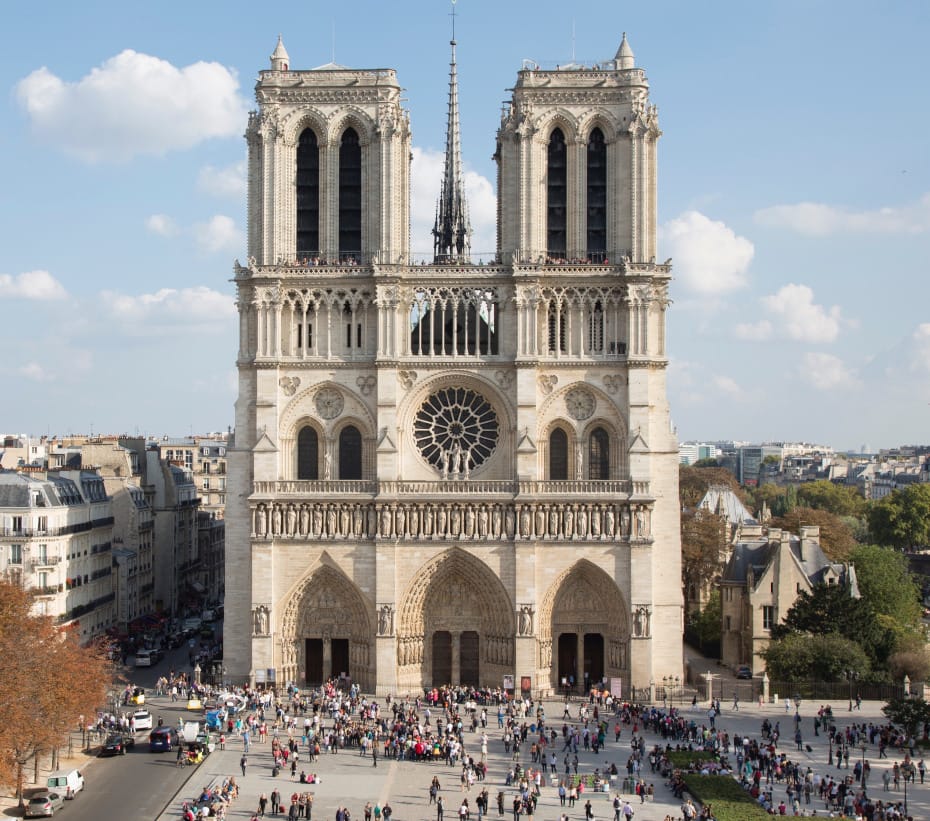
Explore The Western Facade of Notre-Dame Cathedral in Paris, France, a stunning masterpiece of Gothic art, history, and architectural innovation.
<h2>Overview</h2><p>The Western Facade of Notre-Dame Cathedral in Paris, France, stands as a breathtaking testament to Gothic architectural genius, an iconic masterpiece that has greeted pilgrims and visitors for centuries. It is the principal entrance, a grand visual narrative carved in stone, and a crucial component of the cathedral's structural and symbolic integrity. Measuring approximately 41 meters (134.5 feet) wide and 69 meters (226 feet) high to the top of its towers, this facade is more than just a wall; it's a meticulously designed 'book in stone' meant to instruct and inspire. Its balanced composition, a rhythmic interplay of horizontal and vertical lines, was considered an architectural innovation of its time, so harmonious that the architect Le Corbusier later described it as a 'pure creation of the spirit managed by the square and the circle,' symbolizing the rational and the divine.</p><h2>History & Cultural Background</h2><p>The ambitious construction of the Western Facade began around 1200 under Bishop Eudes de Sully, following the laying of the cathedral's cornerstone in 1163. Its completion spanned decades, with the North Tower finished by 1240 and the South Tower by 1250, marking a significant milestone in the cathedral's overall construction which stretched into the mid-14th century. This grand entrance was built upon layers of history, as the site itself once housed a Gallo-Roman temple dedicated to Jupiter, followed by early Christian basilicas. Over its long history, the facade has witnessed countless pivotal moments in French history, from royal coronations to revolutionary turmoil. During the tumultuous French Revolution, many of its statues, particularly those of the Gallery of Kings, were tragically mistaken for French monarchs and largely beheaded or destroyed. The facade, along with the rest of the cathedral, suffered neglect and damage, but a major restoration effort in the 19th century, famously championed by architect Eugène Viollet-le-Duc and popularized by Victor Hugo's novel 'The Hunchback of Notre-Dame,' revived its former glory, replacing many of the damaged elements.</p><h2>What Makes It Special</h2><p>The Western Facade's distinctiveness lies in its rich sculptural program and innovative design. At its base, three monumental portals, each adorned with intricate carvings, serve as gateways to both the physical and spiritual realms. The central Portal of the Last Judgment vividly depicts the resurrection of the dead, the judgment, and Christ enthroned, acting as a visual sermon for a largely illiterate populace. To the left is the Portal of the Virgin, illustrating the life of the Virgin Mary, while the right features the Portal of Saint Anne, which contains some of the cathedral's oldest and most precious sculptures, including a 12th-century depiction of the Virgin and Child. Above these portals stretches the Gallery of Kings, a row of 28 statues representing the Kings of Judah and Israel. Although many were decapitated during the Revolution, their restored presence continues to awe. Dominating the center of the upper facade is the magnificent West Rose Window, a circular masterpiece of stained glass that, at 10 meters (32.8 feet) in diameter, was once the largest of its kind. This pioneering use of expansive windows, supported by ingenious Gothic structural elements, allowed for an unprecedented influx of divine light into the cathedral's interior, transforming the spiritual experience.</p><h2>Stories, Fun Facts & Local Details</h2><p>The Western Facade is steeped in fascinating legends and historical tidbits. One enduring tale concerns the exceptionally intricate ironwork of the central portal's doors. Legend suggests that the craftsman, a young metalworker named Biscorn, was unable to complete such a complex task alone and sought the devil's assistance, paying for it with his soul. Another version suggests he simply worked himself to death from the immense effort. His miraculous work, so perfect it was believed to be supernatural, became a source of both admiration and fear. A more historically verifiable, yet equally dramatic, story is that of the Gallery of Kings. During the French Revolution, their heads were mistaken for those of French royalty and were systematically removed and discarded. Many of these original heads were later discovered during an excavation in 1977 and are now housed in the Musée de Cluny. Furthermore, just outside the facade, on the parvis, lies a small brass plate marking the 'Point Zéro des Routes de France.' This spot is considered the official center of Paris and the point from which all distances in France are traditionally measured.</p><h2>Visitor Perspective</h2><p>Approaching Notre-Dame from the parvis, the Western Facade immediately commands attention, its sheer scale and intricate details drawing the eye upwards. Even amidst the ongoing restoration efforts, the facade offers a profound visual and emotional experience. Visitors are invited to spend time examining the narratives sculpted into the portals, piecing together the biblical stories and historical events they portray. Imagining the vibrant colors that once adorned these sculptures only deepens the appreciation for the medieval artistry. While access to the top of the towers, which offers panoramic views of Paris and close-ups of the famous gargoyles and chimeras, is currently limited due to the fire, the ground-level experience of the facade remains powerful. It stands as a powerful symbol of endurance, faith, and the enduring human quest for beauty and meaning, inviting every curious traveler to connect with centuries of history and art.</p>
Location
Coordinates: 2.35, 48.85306
View on Google Maps