The Temple of Dendur
New York, United States

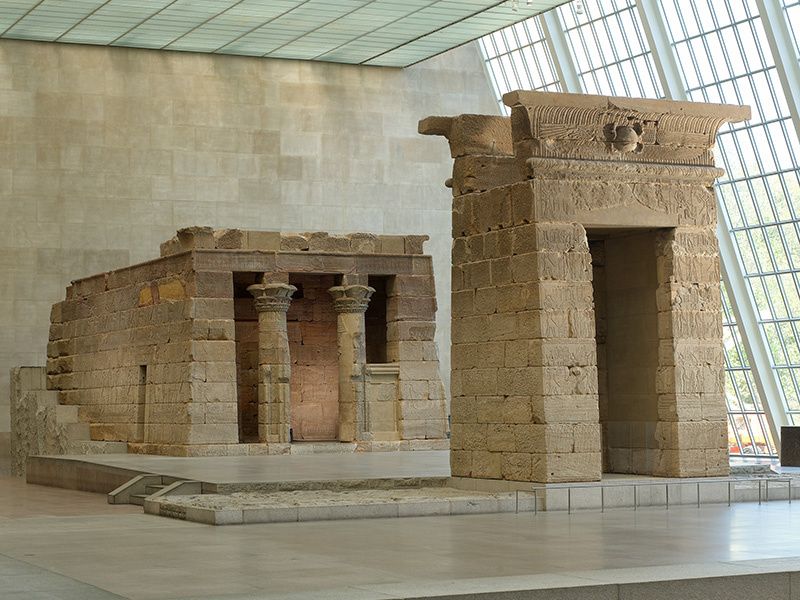
Explore the ancient Temple of Dendur at The Metropolitan Museum of Art in New York, United States. Discover its history, relocation from Egypt, and cultural significance.
<h2>Overview</h2><p>Stepping into The Metropolitan Museum of Art in New York, United States, visitors can embark on a journey back in time to ancient Egypt. Nestled within its walls is The Temple of Dendur, a remarkable monument that once stood proudly on the banks of the Nile River in Nubia, near modern-day Aswan. This relatively modest yet profoundly significant Egyptian temple was commissioned by Emperor Augustus around 15 BCE and completed by 10 BCE. It was dedicated to the goddess Isis and two deified Nubian brothers, Pedesi and Pihor. Today, this ancient structure offers a unique window into a pivotal period of Egyptian and Roman history, remarkably preserved within a custom-built gallery designed to evoke its original riverside setting.</p><h2>History & Cultural Background</h2><p>The Temple of Dendur's origins lie in the early Roman period, following Augustus's conquest of Egypt in 31 BCE. To legitimize Roman rule and foster goodwill with the conquered Egyptian people, Augustus adopted the role of a pharaoh and commissioned several temples dedicated to Egyptian deities. The Temple of Dendur served as a local cult center, honoring Isis and the Nubian brothers Pedesi and Pihor, whose deification likely stemmed from their venerated deaths, possibly by drowning in the Nile. Constructed from local Nubian sandstone, the temple's architecture showcases a blend of traditional Egyptian style with subtle Roman-era influences. Its outer walls feature sunk relief carvings depicting Emperor Augustus as a pharaoh making offerings to various Egyptian gods and the local heroes. Inside, raised reliefs allowed figures to be easily seen in indirect light. Interestingly, in the sixth century, the temple was repurposed as a church by Coptic Christians, who carved crosses and defaced some pagan reliefs.</p><p>The temple's journey to New York is a testament to international cooperation in cultural preservation. In the 1960s, the construction of the Aswan High Dam threatened to submerge numerous ancient monuments, including Dendur, beneath the rising waters of Lake Nasser. UNESCO launched an international campaign to rescue these treasures, with the United States providing significant aid. In gratitude, Egypt gifted the Temple of Dendur to the United States in 1965. After a competitive selection process dubbed the 'Dendur Derby,' The Metropolitan Museum of Art was chosen as its new home in 1967, largely due to its innovative proposal to house the temple indoors in a climate-controlled environment. The temple was meticulously dismantled into 660 massive blocks, weighing over 800 tons, and shipped across the Atlantic. It was then painstakingly reassembled at The Met, opening to the public in 1978.</p><h2>What Makes It Special</h2><p>The Temple of Dendur stands as a singular example of an intact ancient Egyptian temple outside of Egypt, offering an unparalleled opportunity to experience such a structure firsthand. Its preservation and relocation highlight a significant chapter in global heritage efforts. The design ingeniously integrates Egyptian religious tradition with Roman imperial authority, with Emperor Augustus depicted in traditional pharaonic regalia, asserting his legitimacy through local religious iconography. The temple was constructed from durable Nubian sandstone, demonstrating a continuity of ancient Egyptian stoneworking techniques even under Roman patronage. The meticulous installation at The Met's Sackler Wing (now Gallery 131) is a marvel in itself, featuring a large reflecting pool that mimics the Nile and a soaring glass wall overlooking Central Park. This setting creates a harmonious and evocative atmosphere, allowing natural light to illuminate the ancient stone. While the temple now appears in the natural beige of its sandstone, digital projections have revealed its original vibrant painted colors, a common feature of ancient Egyptian temples.</p><h2>Stories, Fun Facts & Local Details</h2><p>The tale of the Temple of Dendur is rich with fascinating details. The dedication to Pedesi and Pihor, two local Nubian figures, alongside major Egyptian deities, underscores the temple's localized religious significance and Augustus's strategic integration with local beliefs. The dramatic 'Dendur Derby' saw more than twenty American cities vying to house the temple, with the Met ultimately winning due to its superior environmental and display plan. Reportedly, Jacqueline Kennedy played a role in advocating for the temple's acquisition by the U.S. Upon its arrival in New York, the temple blocks were temporarily stored in the Met's parking garage before their reconstruction. The temple's architectural details are rich with symbolism; carvings of papyrus and lotus plants line its base, representing the fertile earth and the Nile's life-giving waters, while images of the sun disk and winged vultures adorn the upper sections, symbolizing the sky. Nineteenth-century tourists even left their mark, carving graffiti into its ancient walls, providing a curious historical layer to the monument.</p><h2>Visitor Perspective</h2><p>Visiting The Temple of Dendur offers an exceptionally intimate encounter with ancient history. Visitors can walk freely through the temple's entrance hall and into its inner chambers, studying the intricate carvings and hieroglyphs up close. The expansive glass wall facing Central Park, coupled with the reflecting pool, masterfully recreates the open-air, riverside experience of its original setting in Nubia, enhancing the sense of immersion. The space is designed to transport you, providing a tranquil escape from the bustling city outside. It's a place where you can ponder the stories of ancient gods, Roman emperors, and the incredible journey of a monument saved from oblivion. The Temple of Dendur remains one of The Met's most beloved and iconic exhibits, continually inspiring awe and wonder in millions of visitors from around the world.</p>
Location
Coordinates: -73.963402, 40.779434
View on Google Maps