The Great Organ
Paris, France

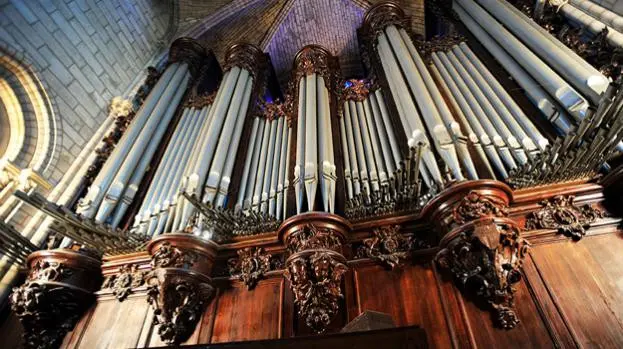
Discover The Great Organ of Notre-Dame Cathedral in Paris, France—its rich history, unique features, and miraculous restoration after the 2019 fire.
<h2>Overview</h2><p>Deep within the revered Notre-Dame Cathedral in Paris, France, resides an instrument of profound historical and cultural significance: The Great Organ. Widely celebrated as the largest musical instrument in France, this monumental organ is much more than a collection of pipes; it is the veritable voice and beating heart of the cathedral itself.</p><p>Boasting approximately 8,000 pipes, a console featuring five keyboards and a pedalboard, and 109 stops, The Great Organ commands both immense scale and intricate detail. Its largest pipes reach an impressive 32 feet tall, contributing to its unparalleled sonic presence within the grand Gothic structure. Though the devastating fire of April 2019 brought global attention and destruction to Notre-Dame, the Great Organ miraculously survived the direct flames, a testament to its robust construction and the efforts to protect it.</p><h2>History & Cultural Background</h2><p>The journey of The Great Organ is a rich tapestry woven through centuries of French history. Its origins can be traced back to the 13th and 14th centuries, with the first documented organ in Notre-Dame appearing as early as 1357, suspended in a 'swallow's nest' in the nave. A new, more substantial organ was completed in 1403, marking the beginning of the instrument's continuous evolution.</p><p>Over the centuries, the organ underwent numerous transformations and expansions, reflecting changing musical styles and technological advancements. Key figures in its development include the master organ builder François Thierry, who undertook a significant renovation in the 1730s, shaping the instrument into what became known as The Great Organ with its distinctive Louis XV-style case. However, it was the 19th-century work of the renowned French organ builder Aristide Cavaillé-Coll, between 1863 and 1868, that cemented its status as an exceptional symphonic instrument. Cavaillé-Coll integrated much of the previous pipework while expanding its capabilities, making it one of the world's largest at the time.</p><p>Throughout its history, The Great Organ has witnessed pivotal moments in France, from royal weddings and coronations to the liberation of Paris in 1944. Many celebrated organists have held the esteemed position of titular organist, contributing to the instrument's global reputation and its role as the 'voice' of the cathedral.</p><h2>What Makes It Special</h2><p>What truly sets Notre-Dame's Great Organ apart is its extraordinary complexity and the unique way it interacts with its surroundings. With nearly 8,000 pipes, 115 stops, and five keyboards, it presents an awe-inspiring array of tonal possibilities. The sheer number of pipes, varying from mere centimeters to 10 meters in length, allows for an immense dynamic and timbral range, capable of producing sounds that fill the vast expanse of the cathedral.</p><p>The acoustics of Notre-Dame Cathedral are integral to the organ's special character. The monumental nave amplifies its sound, allowing chords to reverberate for several seconds, creating a physical sensation where deep bass notes can be felt in one's chest. This unique acoustic environment contributes to a sound described as 'absolutely unusual, that exists nowhere else.' The organ is often referred to as a 'palimpsest,' with layers from different eras—its 18th-century case, pipes from the 17th, 18th, 19th, 20th, and even 21st centuries—each contributing to its rich, evolving character.</p><h2>Stories, Fun Facts & Local Details</h2><p>The 2019 fire brought forth a poignant chapter in The Great Organ's story. Despite the catastrophic damage to the cathedral's roof and spire, the organ itself was largely spared from direct fire damage, protected by the vaulted stone ceiling. However, it was not unscathed; the instrument became coated in toxic lead dust from the melted roof and suffered some water damage and thermal stress from the heatwave that followed.</p><p>The subsequent restoration project, commenced in late 2020, was a monumental undertaking. It involved the painstaking dismantling of every one of its 8,000 pipes, the console, and mechanical components. Each piece had to be individually cleaned and decontaminated from lead, and the leather components essential for airflow were replaced. The reassembly and meticulous tuning, a process that alone takes about six months, were carefully carried out to ensure the organ would once again resonate perfectly with the cathedral's acoustics.</p><p>Being named a titular organist at Notre-Dame is considered among the highest honors for French musicians, reflecting the profound cultural and spiritual role the instrument plays. Miraculously, the Grand Organ was played again in public on December 7, 2024, during the cathedral's reopening, with the Archbishop of Paris giving the command, 'Awake oh organ, Let God's praise be heard!'</p><h2>Visitor Perspective</h2><p>For any traveler exploring Paris, experiencing The Great Organ of Notre-Dame is an unforgettable encounter with history and artistry. While the cathedral itself is projected to reopen to the public in December 2024, the return of the organ's majestic sound marks a significant moment in its rebirth. To truly appreciate its grandeur, visitors might consider attending a Sunday Mass, where the instrument uses the entire building as a massive speaker, creating a deeply moving and immersive experience. The meticulous restoration ensures that future generations will continue to be touched by the extraordinary 'voice' of Notre-Dame, a symbol of resilience and enduring beauty.</p>
Location
Coordinates: 2.349902, 48.852966
View on Google Maps