The Coronation Chair
London, United Kingdom

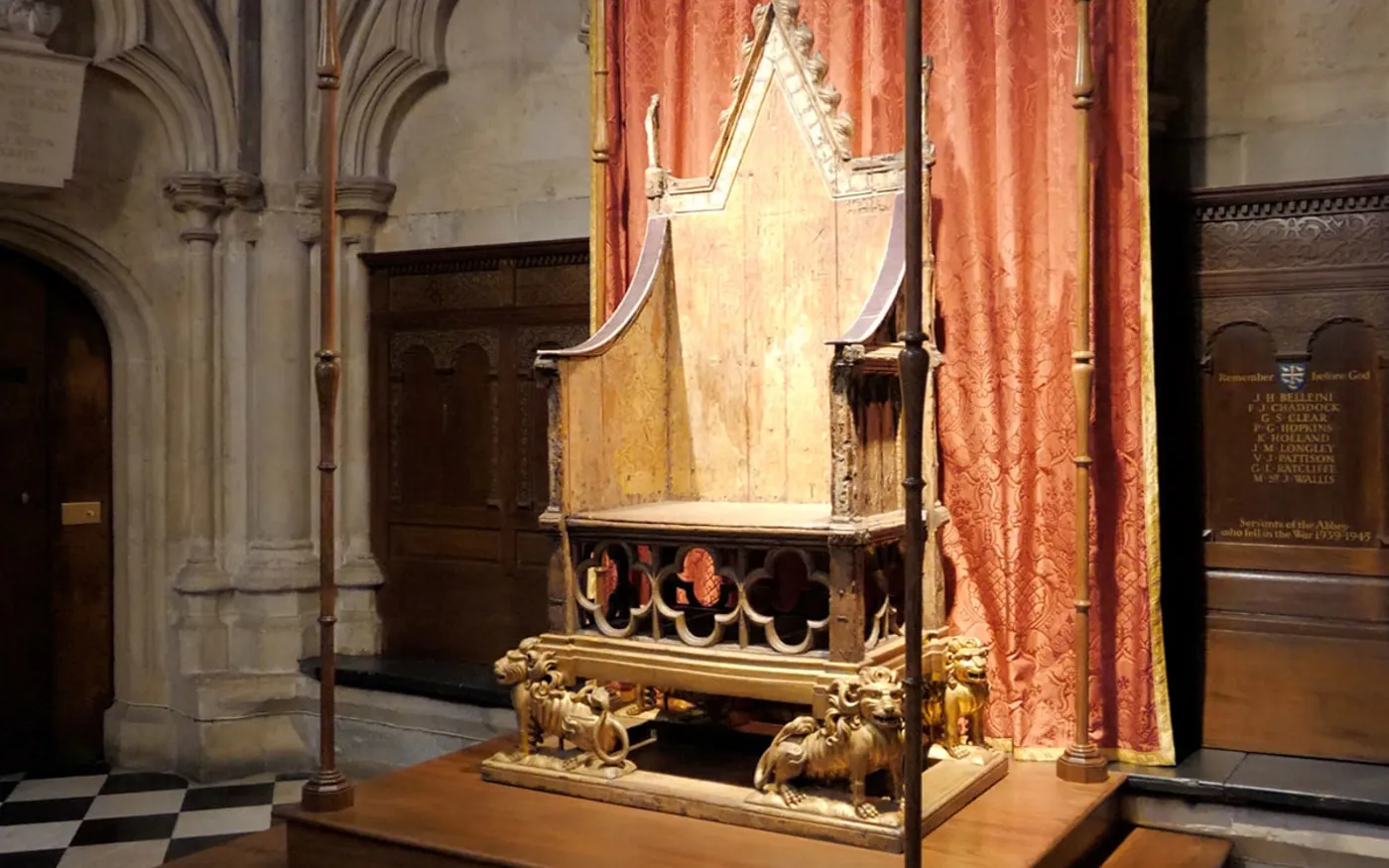
Discover the historic Coronation Chair at Westminster Abbey in London, United Kingdom. Witness over 700 years of British monarchy's crowning history, linked to the legendary Stone of Scone.
<h2>Overview</h2><p>Deep within the hallowed halls of Westminster Abbey in London, United Kingdom, lies a remarkable piece of history: The Coronation Chair. Also known as St Edward's Chair or King Edward's Chair, this ancient oak throne has been central to the British monarchy for over seven centuries. Commissioned by King Edward I between 1296 and 1301, its primary purpose was to encase the legendary Stone of Scone, also known as the Stone of Destiny. Since 1308, it has served as the sacred seat upon which almost every English and later British monarch has been crowned, making it the oldest piece of furniture in the United Kingdom still used for its original, profound purpose.</p><p>Standing tall at 2.05 meters (6 feet 9 inches), the chair is a silent witness to the ebb and flow of British history, embodying continuity and tradition. Its aged appearance belies a rich past, filled with stories of kings, queens, and political intrigue.</p><h2>History & Cultural Background</h2><p>The story of the Coronation Chair begins with King Edward I, who, in 1296, brought the revered Stone of Scone from Scotland to Westminster Abbey. This act was a powerful symbol of English dominion over Scotland, and Edward I ordered the creation of a magnificent chair to house this captured emblem of Scottish royal authority.</p><p>Crafted from oak by the royal carpenter Master Walter of Durham between 1297 and 1300, the chair was originally a lavish affair. It was adorned with gilding, painted patterns of birds, foliage, and animals, and even featured an image of a king, possibly Edward the Confessor or Edward I, with his feet resting on a lion. Though much of this original decoration has faded or been lost to time, traces of its former glory can still be observed. The four gilt lions that support the chair's base were added in the early 16th century and replaced in 1727.</p><p>The Stone of Scone itself carries millennia of legend, with some traditions tracing its origins back to biblical times as Jacob's pillow. It had been used for centuries in the coronations of Scottish kings. The chair first saw use for a coronation in 1308 for Edward II, though it was certainly used for the crowning of Henry IV in 1399, establishing its enduring role. Until the 17th century, monarchs sat directly on the Stone of Scone, with a cushion for comfort, before a wooden platform was added to the chair's seat.</p><h2>What Makes It Special</h2><p>What sets the Coronation Chair apart is its unparalleled role as a tangible link to over 700 years of British monarchical history. It has been the literal seat of power for the most pivotal moment in a sovereign's reign – their coronation. With only a few exceptions, every crowned monarch of England and Great Britain, from Edward II to King Charles III, has sat upon this very chair during their anointing, investiture, and crowning ceremonies.</p><p>Its remarkable longevity and continuous use for its original function make it a unique artifact not just in Britain, but globally. It is more than just a piece of furniture; it is a profound symbol of continuity, tradition, and the enduring heritage of the British Crown. The chair, along with the Stone of Scone it once housed, represents the union of the kingdoms and the symbolic transfer of authority through the ages.</p><h2>Stories, Fun Facts & Local Details</h2><p>The Coronation Chair holds many fascinating stories and bears the marks of its long life. In the 18th and 19th centuries, the Abbey was less strictly guarded, leading to an intriguing phenomenon: visitors, including Westminster schoolboys, carved their names and initials into the ancient oak. This 'graffiti' remains visible today, a quirky testament to a bygone era.</p><p>It has also endured significant events. In 1914, it suffered minor damage from a bomb attack, believed to have been carried out by suffragettes. The chair has left Westminster Abbey on only a few occasions: once in the 17th century when Oliver Cromwell was installed upon it as Lord Protector in Westminster Hall, and again during the Second World War. During WWII, it was secretly evacuated to Gloucester Cathedral for safekeeping, while the Stone of Scone was buried within the Abbey grounds.</p><p>The Stone of Scone itself has had its own dramatic journey. On Christmas Day 1950, it was famously stolen by Scottish nationalists from the Abbey, only to be recovered months later. In 1996, the Stone was officially returned to Scotland, with the understanding that it would be brought back to Westminster Abbey for future coronations, a tradition upheld for the crowning of King Charles III in 2023.</p><h2>Visitor Perspective</h2><p>For any traveler exploring Westminster Abbey, a visit to The Coronation Chair offers a tangible connection to centuries of royal history. Typically, the chair can be found within the historic St George's Chapel inside the Abbey, often displayed behind glass to aid its preservation and ongoing conservation efforts.</p><p>While it usually rests in this dedicated chapel, its central role is revived during coronation ceremonies when it is carefully moved to the center of the Abbey, facing the High Altar. Being able to see this iconic piece of furniture provides a powerful sense of the continuity of British heritage and the profound traditions that continue to shape the nation. It's a highlight that offers a moment of reflection on the many monarchs who have sat upon it.</p>
Location
Coordinates: -0.127465, 51.49939
View on Google Maps