The Audience Chamber
Istanbul, Turkey

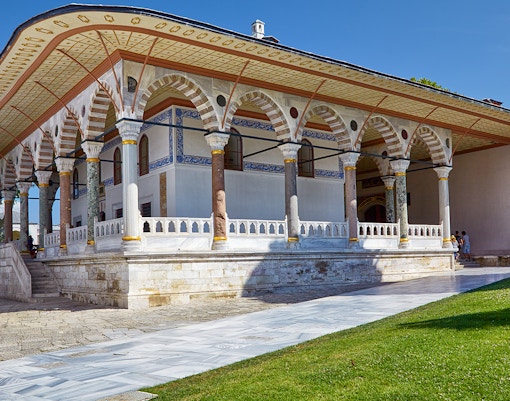
Discover The Audience Chamber (Arz Odası) at Topkapi Palace in Istanbul, Turkey, the historic heart of Ottoman power and diplomacy.
<h2>Overview</h2><p>Nestled within the venerable confines of Istanbul, Turkey's Topkapi Palace, The Audience Chamber – known in Turkish as the Arz Odası – stands as a profound symbol of Ottoman imperial power and diplomacy. Positioned strategically behind the Gate of Felicity, this significant structure served as the formal throne room where sultans engaged with their most trusted officials and received foreign ambassadors. It was the very heart of state administration, a place where critical decisions were made and the majesty of the Ottoman Empire was strikingly displayed.</p><p>Separating the administrative Second Courtyard from the Sultan's private Third Courtyard, the Audience Chamber was more than just a room; it was a stage for meticulously choreographed rituals designed to impress and assert the Sultan's absolute authority. Its architecture and ceremonial function underscore its pivotal role in shaping Ottoman history for centuries.</p><h2>History & Cultural Background</h2><p>The origins of the Audience Chamber trace back to the 15th century, commissioned by Sultan Mehmed the Conqueror himself. Over its long history, the chamber underwent several transformations, notably being refurbished by Sultan Ahmed III in 1723 and extensively rebuilt after a devastating fire in 1856 during the reign of Abdülmecid I. This resilience reflects its enduring importance within the palace complex. As the 'sanctum sanctorum of governance' and the 'High Office' (makam-ı muallâ), it was the ultimate point of contact between the Sultan and the affairs of state.</p><p>Culturally, the Audience Chamber epitomized the Ottoman understanding of sovereignty and governance. It was here that the Grand Vizier would present the outcomes of the Imperial Council meetings directly to the Sultan, emphasizing that while the Divan was advisory, the ultimate decision-making power lay solely with the ruler. This intricate protocol reinforced the Sultan's image as the 'Shadow of God on Earth,' a divine embodiment of authority.</p><h2>What Makes It Special</h2><p>The Audience Chamber is a masterpiece of Ottoman kiosk architecture, a square building distinguished by a colonnade of 22 columns supporting its expansive roof with elegant overhanging eaves. Its interior was once a riot of opulent detail: the ceiling painted a deep ultramarine blue, studded with golden stars, while the walls were adorned with striking blue, white, and turquoise tiles. The throne itself, a focal point of power, was richly decorated, featuring a lacquered ceiling embedded with jewels and motifs depicting the mythical fight between a dragon, symbolizing power, and the simurg, a legendary bird.</p><p>Beyond its visual splendor, the chamber incorporated ingenious design elements. A small marble fountain near the entrance served a dual purpose: aesthetic beauty and strategic sound-muffling to prevent eavesdropping on sensitive discussions. The very acoustics of its domed ceiling were meticulously crafted to allow the Sultan to hear clearly without needing to raise his voice, adding to the aura of his silent power.</p><h2>Stories, Fun Facts & Local Details</h2><p>The Audience Chamber was a place of immense tension and drama. Officials summoned to the chamber for a report might enter without knowing if they would leave alive, a stark reminder of the Sultan's absolute and often swift justice. Foreign ambassadors, often elaborately dressed in Ottoman robes before their audience, would undergo highly choreographed ceremonies to present their credentials and gifts. This theatrical display was carefully designed to underscore the empire's might and the Sultan's supreme position.</p><p>The chamber's four symbolic entrances were said to represent the pillars of Ottoman governance: justice, faith, military strength, and knowledge. Every architectural detail and movement within the room was part of a grand performance, transforming diplomatic meetings into powerful statements of control and prestige. This 'theater of control' ensured that every visitor, from a vizier to an envoy, understood their position relative to the imperial sovereign.</p><h2>Visitor Perspective</h2><p>Today, for the curious traveler, stepping into the Audience Chamber offers a unique 'portal into the very essence of imperial theater.' One can almost feel the weighty silence, the perfumed air, and imagine the palpable tension that filled this space for centuries. Standing before the location where the Sultan's throne once stood provides a profound connection to the historical gravitas of Ottoman court life.</p><p>Visitors can appreciate the intricate tilework and architectural details, pondering the countless pivotal moments that unfolded within these walls. It's an opportunity to immerse oneself in the grandeur and strategic brilliance of an empire, understanding how space, ceremony, and power intertwined to create an awe-inspiring seat of authority. It is a powerful reminder that this was not merely a room, but the physical embodiment of the Sultan's power and his world.</p>
Location
Coordinates: 28.983269, 41.011574
View on Google Maps