Ramakien Murals
Bangkok, Thailand

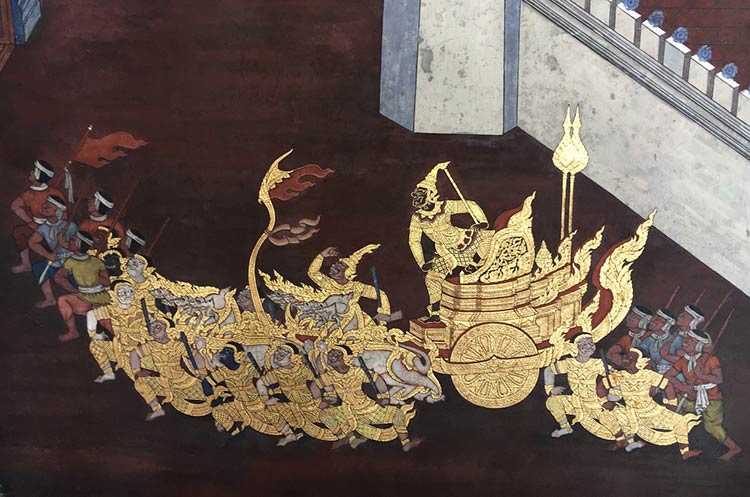
Explore the Ramakien Murals at Wat Phra Kaew in Bangkok, Thailand. Discover the vibrant epic tale of good vs. evil and Thai culture.
<h2>Overview</h2><p>Nestled within the sacred grounds of Wat Phra Kaew, or the Temple of the Emerald Buddha, in Bangkok, Thailand, are the breathtaking Ramakien Murals. These vibrant and intricate paintings adorn the cloister walls surrounding the main temple, presenting a continuous visual narrative spanning over two kilometers. Comprising 178 panels, the murals illustrate the complete epic tale of the Ramakien, Thailand's national epic, offering visitors a profound immersion into Thai culture, mythology, and artistry. Each panel is a masterpiece, rich in color and detail, depicting dramatic scenes of ancient battles, mythical creatures, and heroic adventures. The murals begin at the north gate and unfold sequentially in a clockwise direction, guiding observers through the epic's twists and turns.</p><h2>History & Cultural Background</h2><p>The Ramakien Murals trace their origins back to the late 18th century. They were first commissioned in 1783 by King Rama I, the founder of Thailand's Chakri Dynasty, during the construction of the Grand Palace and Wat Phra Kaew. The Ramakien itself is the Thai adaptation of the ancient Indian epic, the Ramayana, a story that arrived in Southeast Asia through centuries of cultural exchange via traders and scholars. While sharing the core narrative of good versus evil found in its Indian counterpart, the Thai version reinterprets the epic through a distinctly Thai lens, incorporating elements of Buddhist morality and Thai royal ideology. The epic is central to Thai culture, influencing not only visual arts but also literature, dance, such as the classical Thai masked dance-drama known as Khon, and various other art forms.</p><h2>What Makes It Special</h2><p>What truly sets the Ramakien Murals apart is their immense scale, artistic detail, and their role as a living encyclopedia of Thai mythology and moral teachings. Spanning 178 panels along a two-kilometer corridor, they are considered one of the most extensive mural paintings in the world. The artwork showcases stylized figures, vibrant colors, and meticulous linework, often highlighted with liberal applications of gold paint, creating a visually stunning experience. Beyond their aesthetic appeal, the murals are a profound cultural artifact, emphasizing values of honesty, faith, and devotion, and portraying Phra Ram, the epic's hero, as an ideal king embodying compassion and righteousness. The artists skillfully integrated elements of Thai life and architecture into the depictions, with King Rama's palace in the murals often resembling the structure and design of the Grand Palace itself.</p><h2>Stories, Fun Facts & Local Details</h2><p>The central narrative of the Ramakien revolves around the virtuous Prince Phra Ram (an incarnation of Vishnu, and sometimes viewed as an early incarnation of Buddha) and his quest to rescue his abducted wife, Nang Sida, from the ten-headed demon king Thotsakan. Phra Ram is aided by his loyal younger brother, Phra Lak, and the powerful white monkey general, Hanuman, whose magical powers and mischievous nature play a pivotal role in the struggle against Thotsakan's demon army. A fascinating local detail is that the artists, during the original creation and subsequent restorations, sometimes hid small, humorous, or culturally significant 'secrets' in the corners of the panels. These unexpected images, often depicting scenes of daily life or playful surprises, can be found by those who look closely, adding a layer of human charm to the epic narrative.</p><h2>Visitor Perspective</h2><p>A visit to the Ramakien Murals at Wat Phra Kaew offers a unique journey through Thailand's rich storytelling tradition. As you walk along the cloister walls, following the story in a clockwise direction, you are invited to slow down and appreciate the intricate details of each panel. The sheer volume of artwork can be overwhelming, so taking your time or even considering a knowledgeable guide can enhance the experience significantly, helping to unravel the complex storyline and cultural nuances. Remember that Wat Phra Kaew is a sacred site, and a strict dress code is enforced, requiring appropriate attire that covers shoulders and knees. While the temple grounds are often bustling with tourists, especially in the late morning, the murals offer a quieter, more contemplative space to connect with centuries of Thai art and history.</p>
Location
Coordinates: 100.49118, 13.7503
View on Google Maps