Prayer Hall and Carpeted Floor
Istanbul, Turkey

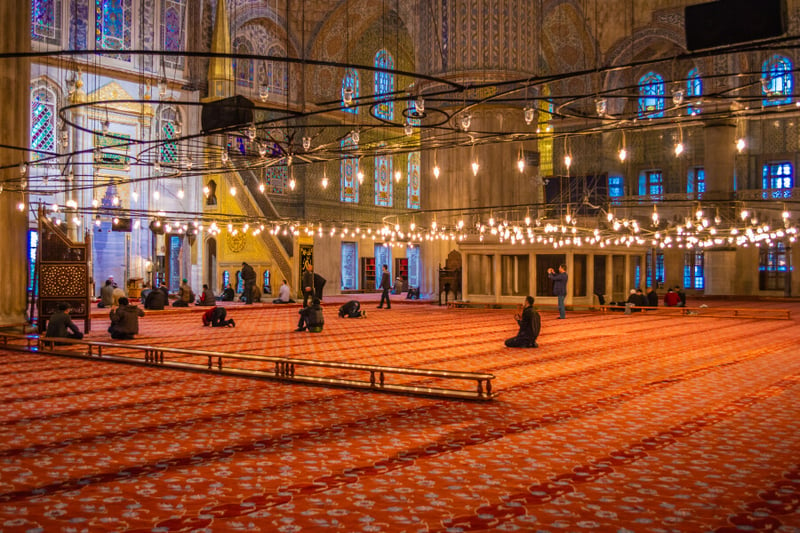
Explore the majestic Prayer Hall and its soft carpeted floor inside Istanbul's Blue Mosque, a masterpiece of Ottoman architecture and faith.
<h2>Overview</h2><p>Stepping into the Prayer Hall of the Sultan Ahmed Mosque, globally known as the Blue Mosque, in Istanbul, Turkey, is to enter a realm of profound spirituality and architectural splendor. This magnificent space, a focal point of Islamic worship, is renowned for its breathtaking aesthetics and serene atmosphere. The prayer hall, with its vast expanse and intricate details, invites contemplation and awe. At its heart lies the expansive, richly patterned carpeted floor, guiding the faithful and cushioning the steps of countless visitors who come to witness this Ottoman masterpiece. It is an active mosque, welcoming both worshippers and curious travelers to experience its timeless beauty.</p><h2>History & Cultural Background</h2><p>The construction of the Blue Mosque, officially the Sultan Ahmed Mosque, was commissioned by Sultan Ahmed I between 1609 and 1617. Unlike his predecessors who often funded grand projects with war spoils, Sultan Ahmed I drew from the imperial treasury, a decision that initially met with some controversy. His ambition was to erect a monument that would rival, and perhaps even surpass, the grandeur of the nearby Hagia Sophia, which had been converted into a mosque after the Ottoman conquest. The esteemed architect Sedefkar Mehmed Ağa, a student of the legendary Mimar Sinan, was tasked with bringing this vision to life. The mosque was strategically positioned opposite the Hagia Sophia and adjacent to the ancient Hippodrome, symbolically asserting Ottoman power and Islamic faith in the city's historical core.</p><h2>What Makes It Special</h2><p>The prayer hall's distinctive character stems from its harmonious blend of traditional Islamic and Byzantine architectural elements. A central dome, measuring 23.5 meters (77 feet) in diameter and rising 43 meters (141 feet) high, presides over the space, supported by four massive 'elephant foot' pillars and surrounded by a cascade of semi-domes. This architectural marvel creates an immense sense of openness and height. The interior walls and ceiling are adorned with more than 20,000 handmade Iznik ceramic tiles, predominantly in shades of blue, green, and turquoise, featuring over 50 different tulip designs and floral motifs that lend the mosque its popular 'Blue' moniker. These tiles, particularly those at the gallery level, depict flowers, fruits, and cypress trees, with their color symbolizing the sky and heaven, fostering a serene atmosphere for worship. Natural light streams through more than 200 stained-glass windows, illuminating the intricate calligraphy and tilework. At the southeastern side, the mihrab, a finely carved marble niche indicating the direction of Mecca (qibla), serves as the spiritual heart of the hall, flanked by an exquisitely crafted minbar, or pulpit, from which the Imam delivers sermons.</p><p>The entire prayer hall floor is covered with vast, often vibrantly patterned carpets. These carpets are not merely decorative; they define the sacred space for prayer, providing a clean and soft surface for worshippers. They are frequently replaced, often through donations from the faithful, a testament to the mosque's ongoing role as a living place of worship.</p><h2>Stories, Fun Facts & Local Details</h2><p>One of the most enduring stories associated with the Blue Mosque concerns its six minarets. Legend has it that Sultan Ahmed I requested 'altın minareler' (gold minarets), but the architect, Sedefkar Mehmed Ağa, misheard it as 'altı minare' (six minarets) due to the similarity in pronunciation. At the time, only the Ka'aba in Mecca had six minarets, making the Sultan's mosque unique and somewhat controversial. To resolve this, a seventh minaret was reportedly added to the mosque in Mecca.</p><p>Another fascinating detail, often overlooked, is the historical use of ostrich eggs. These were placed on chandeliers within the prayer hall, believed to repel spiders and thus prevent cobwebs, ensuring the pristine beauty of the interior was maintained. The carpets themselves have a rich history, with patterns and materials changing over time. They are seen as a reward for public service and are made from Turkish wool, embodying a long tradition of mosque carpet culture.</p><h2>Visitor Perspective</h2><p>Visiting the Blue Mosque's prayer hall is a deeply enriching experience, offering a glimpse into centuries of Islamic tradition and Ottoman artistry. As it remains an active place of worship, visitors are requested to observe certain protocols out of respect. Dress modestly, covering shoulders, knees, and for women, their hair. Scarves are provided at the entrance if needed. Before entering the carpeted prayer hall, shoes must be removed and can be carried in provided plastic bags. Silence is encouraged, and photography is permitted without flash, with a mindful approach not to disturb those at prayer. The mosque closes to non-worshippers for approximately 90 minutes during each of the five daily prayers, with Friday midday being particularly busy. Experiencing the quiet grandeur of the prayer hall, walking on the soft carpet, and observing the interplay of light and color from the Iznik tiles is an unforgettable journey into Istanbul's spiritual heart.</p>
Location
Coordinates: 28.977114, 41.005745
View on Google Maps