Observation Capsules
London, United Kingdom

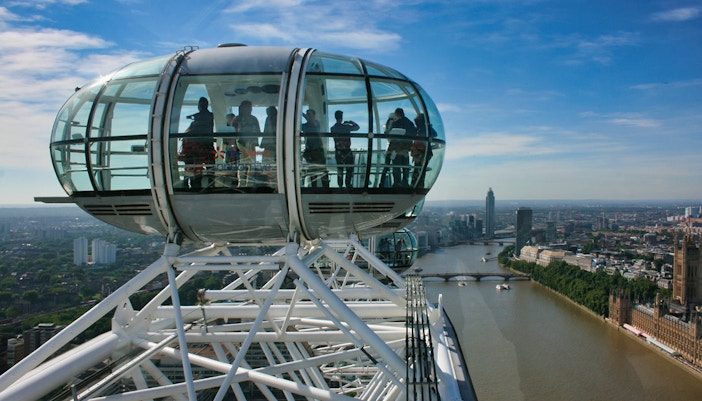
Explore the London Eye's Observation Capsules in London, UK. Discover their unique design, history, and unparalleled panoramic views of the city's iconic landmarks.
<h2>Overview</h2><p>Perched gracefully on the South Bank of the River Thames in London, United Kingdom, the London Eye is a towering cantilevered observation wheel that has become an indelible part of the city's iconic skyline. It was originally known as the Millennium Wheel, a testament to its inception at the turn of the century. Within this architectural marvel are its distinctive Observation Capsules, providing visitors with a truly unique vantage point over the British capital.</p><p>There are 32 sealed and air-conditioned glass capsules attached to the wheel's exterior. Each capsule is ingeniously designed to remain upright as the wheel slowly rotates, ensuring a stable and comfortable journey for all passengers. With a capacity for up to 25 people, a single revolution of the London Eye offers a full 360-degree panoramic vista that captures London's most beloved landmarks. The entire experience unfolds over approximately 30 minutes, a gentle rotation that allows ample time to absorb the breathtaking scenery.</p><h2>History & Cultural Background</h2><p>The concept for the London Eye emerged in 1993 from the minds of architects David Marks and Julia Barfield, a husband-and-wife team. They envisioned a monumental structure to commemorate the new millennium, submitting their design to a competition organized by The Sunday Times and the Architecture Foundation. Although their initial proposal did not win, Marks and Barfield persevered, driven by the idea of offering the public an elevated perspective of London.</p><p>Construction of the London Eye began in 1998, an ambitious undertaking that involved an international team of specialists and parts sourced from across Europe. The wheel was assembled in sections, floated up the Thames on barges, and meticulously laid flat on piled platforms in the river. One of the most remarkable feats of engineering was the delicate process of lifting the entire 135-meter structure into its upright position, a task that took days. Officially opened by Prime Minister Tony Blair on New Year's Eve 1999, technical issues with a capsule clutch mechanism meant it did not welcome paying visitors until March 2000.</p><p>Initially intended as a temporary attraction with a five-year lease, the London Eye's overwhelming popularity quickly cemented its place as a permanent fixture on the city's skyline. It has since become a powerful symbol of modern London, featuring in British passports, on London Underground seating, and as the spectacular focal point for the city's iconic New Year's Eve fireworks display.</p><h2>What Makes It Special</h2><p>The Observation Capsules of the London Eye are more than just viewing platforms; they are a testament to innovative design and engineering. Their most distinctive feature is the unique cantilevered design of the wheel itself, supported only on one side, allowing it to stretch out dramatically over the River Thames. This structural elegance, often compared to a giant spoked bicycle wheel, is both visually striking and functionally brilliant.</p><p>Each of the 32 ovoidal capsules is an engineering marvel, designed to provide unobstructed 360-degree views. They are attached to the external circumference of the wheel and are equipped with a sophisticated system that rotates them to maintain horizontal stability, ensuring passengers always have a level and comfortable experience as the wheel turns. The slow, continuous rotation, at about 26 cm per second, means the wheel rarely needs to stop for boarding, creating a seamless flow for visitors.</p><h2>Stories, Fun Facts & Local Details</h2><p>An intriguing detail about the London Eye's capsules is their numbering system. While there are 32 capsules, they are numbered from 1 to 33, conspicuously skipping number 13. This omission is a nod to a common superstition, avoiding the 'unlucky' number. Each of these 10-tonne capsules is said to represent one of London's 32 boroughs, adding a layer of local symbolism to the experience.</p><p>The construction of the London Eye was a truly pan-European effort. While conceived by a UK design team, the capsules themselves were manufactured by cable-car specialists Poma in the French Alps. Other components, such as the steel, cables, bearings, and the iron spindle, came from various countries including the Netherlands, Italy, Germany, and the Czech Republic. In 2013, one capsule was specially named the 'Coronation Capsule' to mark the 60th anniversary of Queen Elizabeth II's coronation, highlighting its connection to national events.</p><p>Upon its opening in 2000, the London Eye held the title of the world's tallest Ferris wheel. Although it has since been surpassed by others globally, it remains Europe's tallest cantilevered observation wheel and once held the distinction of being London's highest public viewing point before the completion of The Shard. It continues to be a central part of London's New Year's Eve festivities, with thousands of fireworks launched from the wheel itself during the televised display.</p><h2>Visitor Perspective</h2><p>Stepping into one of the London Eye's Observation Capsules offers a remarkably serene and unforgettable journey. The spacious, climate-controlled interiors allow visitors to move freely, providing different perspectives of the city below. As the capsule ascends, the urban tapestry of London unfolds in a spectacular 360-degree panorama. Iconic landmarks such as the Houses of Parliament, Big Ben, Buckingham Palace, St. Paul's Cathedral, and the winding River Thames become visible, offering fantastic photo opportunities and moments of quiet contemplation.</p><p>The gentle, continuous motion of the wheel ensures a smooth ride, making the experience accessible and enjoyable for people of all ages. For those seeking an even more exclusive experience, private capsules can be booked for special occasions, transforming a sightseeing trip into an intimate celebration high above the city. This unique blend of engineering prowess, historical context, and unparalleled views makes a ride in the London Eye's Observation Capsules a truly iconic London adventure.</p>
Location
Coordinates: -0.1197, 51.5033
View on Google Maps