Nighttime Illumination
London, United Kingdom

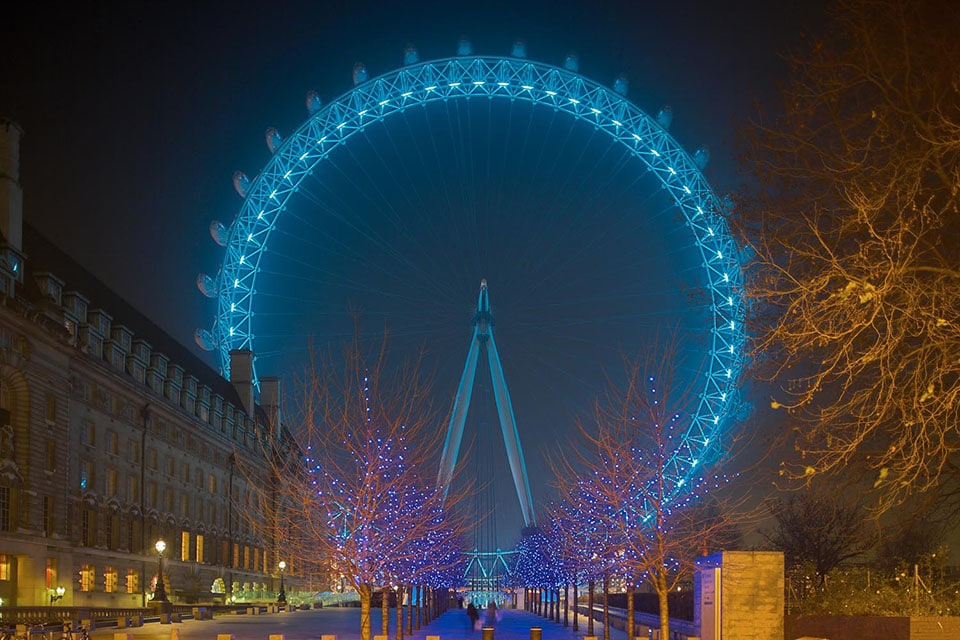
Witness the London Eye's magical Nighttime Illumination in London, United Kingdom. Discover its history, symbolic colors, and stunning views after dark.
<h2>Overview</h2><p>The London Eye, a monumental cantilevered observation wheel on the South Bank of the River Thames, transforms into a dazzling spectacle each evening through its Nighttime Illumination. More than just a landmark, its vibrant light display has become an integral part of London's cityscape after dark, offering both residents and visitors a continuously evolving visual experience. With its strategic location, the illuminated Eye serves as a focal point, reflecting its glow upon the River Thames and enhancing the panoramic views of the city's iconic skyline. The dynamic lighting system, composed of thousands of LED lights, showcases a palette of colors that bring the structure to life, making it a captivating sight from near and afar.</p><p>A ride on the London Eye at night presents a unique perspective, allowing passengers to witness London's historic landmarks sparkling against the dark sky. This nocturnal experience is often described as peaceful and romantic, providing an intimate ambiance away from the daytime crowds. The illumination schedule typically begins at dusk, making the transition from a golden hour glow to a vibrant light show a highlight for many. The wheel's steady rotation ensures ample time to absorb the magical transformation of the capital.</p><h2>History & Cultural Background</h2><p>The London Eye, originally known as the Millennium Wheel, was conceived by architects David Marks and Julia Barfield for a competition to design a landmark for the new millennium. While their design did not win the initial competition, they pursued the project independently, leading to its grand opening in 2000. The concept was to represent time and renewal, with passengers metaphorically turning through time. The initial lighting system of the London Eye was impressive, but a significant upgrade occurred in 2006 when the wheel was equipped with a sophisticated LED lighting system. This technological advancement not only allowed for a wider range of colors and dynamic patterns but also dramatically improved energy efficiency, cutting power consumption by 75% compared to its original halogen systems.</p><p>For a period, the London Eye's illumination served a unique function beyond aesthetics; it predicted the weather. From 2006, as part of a sponsorship, EDF Energy, in partnership with BT and data from the UK Met Office, programmed the lights to reflect weather forecasts. Blue indicated clear skies, green for rain, and red for high temperatures, with flashing yellow signifying fog. However, this weather-forecasting system was retired in 2014 following the end of EDF's sponsorship. Since then, the Nighttime Illumination has pivoted entirely to celebrating events, causes, and brand campaigns, solidifying its role as a cultural canvas for London.</p><h2>What Makes It Special</h2><p>The Nighttime Illumination of the London Eye stands out due to its remarkable adaptability and symbolic significance. Unlike static lighting, the Eye's LED system allows for real-time changes in color and pattern, making it a dynamic part of the city's visual narrative. This flexibility means the Eye can be lit in specific colors to mark a myriad of occasions, from national celebrations and sporting victories to global awareness campaigns and holidays.</p><p>For instance, the Eye often glows in red and gold for Lunar New Year, red and white to support England's sports teams, and rainbow colors during Pride Month. It has also been illuminated in blue for NHS tribute nights or World Autism Awareness Day, pink for Breast Cancer Awareness, and purple for commemorative occasions like Remembrance Sunday. This ability to transform its appearance with purpose makes the Nighttime Illumination a powerful visual communicator, engaging with local and international events and sentiments. It's not merely a light show but a continuous, subtle dialogue with the city and its people, reflecting current moods and celebrating collective moments.</p><h2>Stories, Fun Facts & Local Details</h2><p>One fascinating aspect of the London Eye's illumination is its rich history of signifying events. Beyond its default white light, which denotes neutrality or elegance, the deliberate choice of colors tells a story to those who know how to 'read' the Eye. For example, the wheel has been bathed in pink to commemorate significant social milestones, such as the UK's first civil partnership in 2005. It has also shown patriotic colors, like the Union Jack's red, white, and blue, for royal jubilees and coronations, underscoring its role in national identity and celebration.</p><p>A particularly magical time to witness the Nighttime Illumination is during London's New Year's Eve celebrations. The London Eye becomes the magnificent centerpiece for the city's world-renowned fireworks display, launching thousands of fireworks directly from its structure, synchronized with music and light. This grand spectacle draws millions of eyes globally and has firmly cemented the Eye's place as a symbol of London's welcoming of the new year. Another fun fact is that the London Eye's continuous slow rotation allows passengers to board and disembark without the wheel ever having to stop, a subtle feat of engineering that ensures a steady flow of visitors, day and night.</p><h2>Visitor Perspective</h2><p>Experiencing the London Eye's Nighttime Illumination from the ground is a breathtaking spectacle, a shimmering beacon against the dark London sky. Many visitors choose to stroll along the South Bank of the River Thames, where the reflection of the illuminated wheel on the water adds another layer of beauty to the scene. Capturing photographs of the Eye at night, especially with other lit-up landmarks in the background, is a popular activity, creating lasting memories of London's enchanting evenings.</p><p>For those who choose to ride the Eye after dusk, the perspective shifts dramatically. From inside a capsule, the city unfolds into a vast expanse of twinkling lights below. Iconic structures like the Houses of Parliament, Big Ben, and St. Paul's Cathedral appear bathed in their own nocturnal glow, creating a truly unforgettable 360-degree panorama. Booking a ride just before sunset is a favored option, offering the best of both worlds: witnessing the transition from daylight to twilight and then the full splendor of London illuminated. The slower pace of the evening often leads to a more serene and contemplative experience, perfect for couples or anyone seeking a moment of quiet awe amidst the bustling city.</p>
Location
Coordinates: -0.119527, 51.503464
View on Google Maps