Main Prayer Hall of the Mosque
Antalya, Turkey

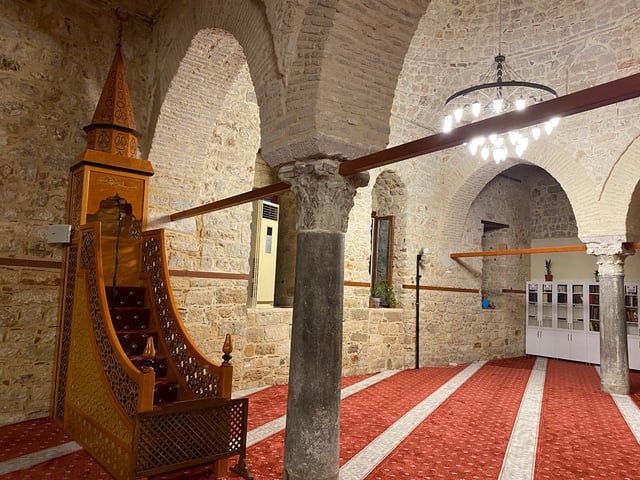
Explore the Main Prayer Hall of Yivli Minaret Mosque in Antalya, Turkey. Discover its Seljuk-era architecture, six domes, intricate details, and rich history.
<h2>Overview</h2><p>Nestled in the heart of Antalya's historic Kaleiçi district, the Main Prayer Hall of the Yivli Minaret Mosque stands as a testament to centuries of rich history and cultural evolution. As an integral part of the larger Yivli Minaret Mosque complex, this prayer hall is more than just a place of worship; it is a significant historical landmark and a proud symbol of Antalya, Turkey. The mosque, particularly renowned for its distinctive fluted minaret, presents a captivating blend of architectural styles. Built originally around 1230 on the foundations of a ruined Byzantine church, the prayer hall we see today was substantially rebuilt in the 14th century, featuring its characteristic six-domed design. It proudly represents one of the oldest examples of multi-domed mosques found across Anatolia. Still an active place of worship, its serene ambiance offers a profound connection to the city's past and present.</p><h2>History & Cultural Background</h2><p>The origins of the Yivli Minaret Mosque complex trace back to a pivotal moment in Antalya's history: the Seljuk conquest of the city in 1226. Following this, the original mosque was commissioned around 1230 by the Seljuk Sultan I. Alaeddin Keykubad, a ruler famed for his extensive architectural patronage. This initial construction cleverly integrated elements from the pre-existing Byzantine church, showcasing a common Seljuk approach to building on historically significant sites. However, the prayer hall was later rebuilt in 1373 by Mehmet Bey of the Hamidids dynasty, giving it the six-domed structure visible today. A fascinating aspect of this reconstruction is the reuse of ancient column heads, likely sourced from Roman or Byzantine-era structures, within the prayer hall's interior. The mosque has undergone numerous restoration efforts throughout the centuries, including significant projects in the 20th and 21st centuries, to preserve its historical integrity. For a period, it even served as the Antalya Museum, further highlighting its cultural importance before resuming its role as a mosque. The Main Prayer Hall, therefore, stands as a living document of the interplay between different cultural and architectural traditions that have shaped Anatolia.</p><h2>What Makes It Special</h2><p>The Main Prayer Hall of the Yivli Minaret Mosque is a remarkable example of early Anatolian Seljuk architecture. Its design features a rectangular plan, crowned by six elegant domes arranged in two symmetrical rows. These domes are supported by twelve robust columns, each topped with the intriguing reused ancient capitals, which add a unique layer of historical depth to the structure. Inside, visitors can observe Seljuk-era tilework and intricate wood carvings that adorn the hall, particularly notable around the Mihrab (prayer niche) and Minbar (pulpit), showcasing the fine craftsmanship of the period. Despite these detailed elements, the interior generally maintains a minimal decorative style, in keeping with the aesthetic principles of early Seljuk art. A truly remarkable discovery during recent restorations was an ancient heating and cooling system, involving water channels beneath the mosque, demonstrating sophisticated engineering from centuries past. This harmonious blend of Byzantine and Seljuk architectural elements creates an atmosphere that is both historically rich and spiritually uplifting.</p><h2>Stories, Fun Facts & Local Details</h2><p>The very name 'Yivli' means 'fluted' or 'grooved' in Turkish, primarily referring to the distinct minaret, but it has become synonymous with the entire complex, embodying its unique character and architectural prominence. Interestingly, the mosque is also known by several other names, including the Aladdin Mosque, the Great Mosque, or the Grand Mosque (Ulu Camii), reflecting its significance through different eras. Such is its iconic status that the image of the Yivli Minaret is not only featured prominently in Antalya's touristic materials but has even been adopted as the logo for the city's football team, underscoring its deep connection to local identity. The prayer hall's serene ambiance, often described by visitors as profoundly peaceful, is enhanced by its location within the charming, labyrinthine streets of Kaleiçi. This historic district is a treasure trove itself, offering easy access to other famous landmarks such as Hadrian's Gate and the ancient Old Harbor, making a visit to the mosque part of a larger historical journey.</p><h2>Visitor Perspective</h2><p>The Main Prayer Hall of the Yivli Minaret Mosque is conveniently situated in the vibrant heart of Kaleiçi, making it easily accessible for anyone exploring Antalya's old town. As it remains a functioning place of worship, visitors are respectfully asked to observe local customs by dressing modestly, ensuring their shoulders and knees are covered. For women, headscarves and skirts are often thoughtfully provided at the entrance, facilitating a respectful and comfortable visit. A visit to this historic site is free of charge, welcoming all who wish to experience its beauty and tranquility. Many travelers describe the atmosphere within the prayer hall as remarkably quiet and peaceful, offering a contemplative escape from the bustling city outside. For those keen on photography, the 'golden hours' of early morning and late afternoon are recommended for capturing the hall's architectural nuances and peaceful aura under the softest light. The Yivli Minaret Mosque complex, including its prayer hall, offers a truly authentic and enriching cultural experience in Antalya.</p>
Location
Coordinates: 30.704444, 36.886389
View on Google Maps