Main Dome
Istanbul, Turkey

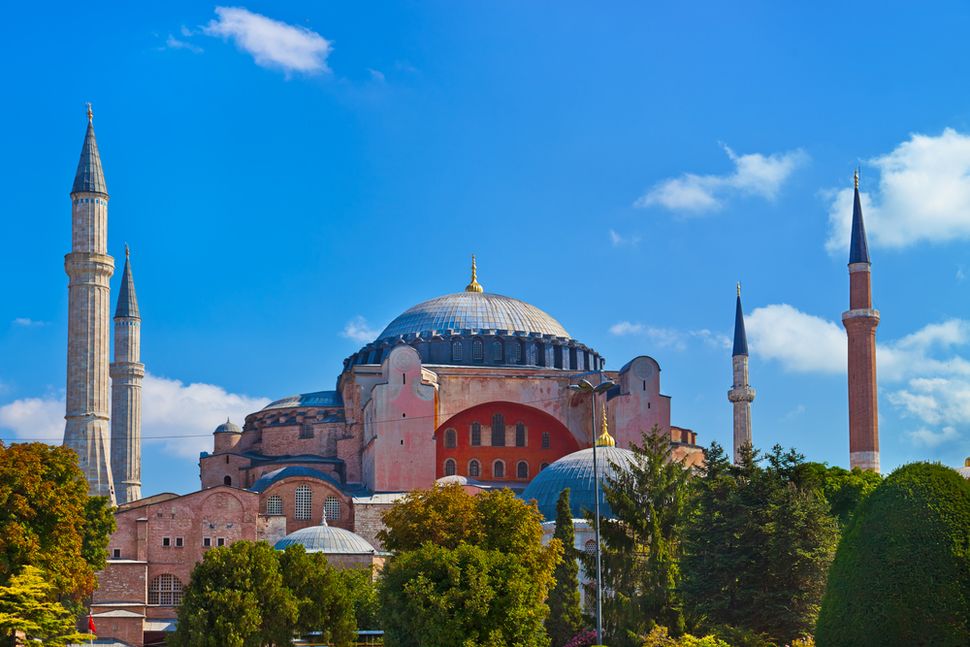
Discover the awe-inspiring Main Dome of Hagia Sophia in Istanbul, Turkey. Explore its groundbreaking Byzantine architecture, rich history, and the mesmerizing illusion of its floating design.
<h2>Overview</h2><p>Stepping inside the Hagia Sophia in Istanbul, Turkey, one's gaze is immediately drawn upwards to its magnificent Main Dome. This colossal architectural achievement is not merely a structural element; it is the very heart of the building's grandeur and a testament to human ingenuity. With a diameter of approximately 31 to 32 meters and rising to a height of around 55.6 to 56 meters from the ground, the dome has long commanded awe and admiration [2, 3, 4]. It dominates the interior space, creating an expansive, ethereal atmosphere that has captivated visitors for centuries. Its sheer scale and the illusion of it 'floating' above the central space make it an unforgettable sight, setting the tone for the entire spiritual and historical experience of the Hagia Sophia.</p><h2>History & Cultural Background</h2><p>The history of the Hagia Sophia's Main Dome is as rich and complex as the edifice itself. The current structure, commissioned by Byzantine Emperor Justinian I, was built between 532 and 537 CE by architects Isidore of Miletus and Anthemius of Tralles [4, 12, 13]. This third iteration of a church on the site was an ambitious project, designed to surpass all previous religious buildings in scale and magnificence. The original dome, however, faced structural challenges and largely collapsed during an earthquake in 558 CE [4, 16, 17]. Emperor Justinian I entrusted its rebuilding to Isidore the Younger, who made structural improvements, including raising the dome's height and incorporating forty windows around its base to reduce weight [5, 17].</p><p>Throughout its lifespan, the dome has witnessed profound cultural shifts. Originally gracing a Christian cathedral, it later became a central feature of an imperial mosque after the Ottoman conquest in 1453 [13]. This transformation brought about new layers of cultural significance, with Islamic calligraphy adorning its interior, often coexisting with earlier Christian mosaics [9, 3]. After serving as a museum for decades, the Hagia Sophia reverted to its status as a mosque in 2020, continuing its journey as a site of immense historical and religious importance for both East and West [13, 12]. Its status as a UNESCO World Heritage site since 1985 underscores its universal value [2, 14].</p><h2>What Makes It Special</h2><p>What truly sets the Hagia Sophia's Main Dome apart is its revolutionary architectural design. The architects, Isidore of Miletus and Anthemius of Tralles, employed the innovative use of pendentives – triangular, curved supports that seamlessly transition the weight of the circular dome onto the square base of the building [3, 11]. This was a groundbreaking technique for its time, allowing for an immense open interior space unlike any seen before [13]. The dome's integration into the structure was so advanced that it was said to have 'changed the history of architecture' [13].</p><p>Another distinguishing feature is the ring of forty windows encircling the dome's base. These windows, added during its reconstruction by Isidore the Younger, not only flood the interior with natural light but also create a breathtaking illusion that the dome floats effortlessly above, disconnected from its supporting walls [5, 9, 16]. This ingenious design was further enhanced by the use of lightweight materials, predominantly brick and mortar, for the dome's construction [4, 16]. Over the centuries, several repairs and reinforcements, including buttresses, were added to ensure its stability, a testament to the continuous effort to preserve this engineering marvel [5].</p><h2>Stories, Fun Facts & Local Details</h2><p>The Main Dome of Hagia Sophia is a treasure trove of stories and fascinating details. The most enduring 'fun fact' is undoubtedly the visual effect created by its windows. As sunlight pours through the forty apertures, especially at certain times of the day, the base of the dome appears to vanish, giving the impression that the massive structure is suspended in mid-air, a celestial canopy [9, 16]. Early visitors and chroniclers, such as Procopius, marveled at how the interior seemed illuminated not from external light, but by a radiance emanating from within [16].</p><p>During its transformation into a mosque, the dome was adorned with magnificent Islamic calligraphy. Verses from the Qur'an related to monotheism, the heavens, sun, stars, and light were inscribed, further layering its spiritual significance [2]. The famous medallion in the center of the dome, featuring intricate Arabic calligraphy, is a prime example of this artistic overlay [3]. These details showcase a unique blend of Byzantine and Ottoman artistic traditions, reflecting the building's multi-layered history. The dome's construction with ribs resembling a scalloped shell also contributed to better weight distribution, a subtle but significant detail of its structural integrity [5].</p><h2>Visitor Perspective</h2><p>For any traveler to Istanbul, experiencing the Main Dome of Hagia Sophia is an essential part of the journey. As one steps beneath its vast expanse, the sheer scale is overwhelming, yet it is simultaneously uplifting. The interplay of light and shadow, dancing across the dome's curves and mosaics, draws the eye ever upward. From the main floor, visitors gain a powerful sense of its immense proportions, while an ascent to the upper galleries offers a closer, more intimate perspective on the intricate details of its construction and decoration [3].</p><p>Whether reflecting on its origins as a symbol of Byzantine imperial power, appreciating its role as a spiritual beacon through different faiths, or simply marveling at its architectural audacity, the dome encourages contemplation. It is a space where history, art, and engineering converge, inviting visitors to ponder the enduring human desire to create something truly magnificent. The Hagia Sophia's Main Dome is more than just a roof; it is a profound testament to centuries of cultural heritage, a silent witness to history, and an awe-inspiring spectacle that continues to leave a lasting impression on everyone who beholds it.</p>
Location
Coordinates: 28.980261, 41.008469
View on Google Maps