Kesik Minare
Antalya, Turkey

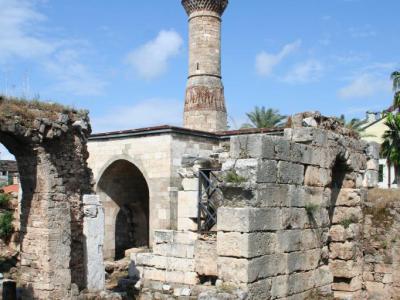
Discover Kesik Minare, the 'Broken Minaret,' in Antalya's Kaleiçi (Old Town), Turkey. Explore its rich history as a Roman temple, Byzantine church, and Ottoman mosque, a true symbol of cultural endurance.
<h2>Overview</h2><p>Kesik Minare, or the 'Broken Minaret,' stands as a profound symbol within the ancient walls of Kaleiçi, Antalya's charming Old Town. It is not merely a ruin but a living testament to the city's layered past, having witnessed the rise and fall of empires, and the ebb and flow of cultures. This captivating structure, with its distinctive truncated minaret, draws visitors into a narrative spanning over two millennia, reflecting Antalya's enduring spirit and transformation. Today, it operates as the Korkut Mosque, inviting contemplation on its complex identity as a site of continuous worship. Its presence among the narrow, winding streets of Kaleiçi makes it an unmissable landmark, seamlessly blending ancient history with the vibrant life of modern Antalya.</p><h2>History & Cultural Background</h2><p>The story of Kesik Minare begins not with a minaret, but as a Roman temple, constructed in the 2nd century AD. This pagan sanctuary was a cornerstone of Roman Pamphylia's religious landscape. Centuries later, in the 7th century AD, the site underwent its first significant transformation, becoming a grand Byzantine church dedicated to the Virgin Mary, often referred to as the Panagia Church. This Christian basilica, incorporating many original Roman elements, suffered considerable damage during the Arab invasions of the 7th century but was subsequently repaired and expanded in the 9th century.</p><p>The early 13th century marked another pivotal moment when the Seljuk Turks conquered Antalya. The Byzantine church was then converted into a mosque, and it was during this period that the iconic minaret was added, signifying its new Islamic purpose. However, its religious identity remained fluid. In 1361, when Peter I, the Crusader King of Cyprus, briefly captured Antalya from the Seljuks, the structure was reconsecrated as a church. This period was short-lived, as Antalya eventually came under Ottoman rule. During the late 15th or early 16th century, specifically under the governorship of Şehzade Korkut, a son of Ottoman Sultan Bayezid II, the building was once again converted into a mosque and became known as the Korkut Mosque.</p><p>Tragedy struck in 1896 when a devastating fire engulfed the main building, leaving much of it in ruins, including the wooden dome and the upper part of the minaret. It was from this event that the minaret earned its poignant name, 'Kesik Minare,' meaning 'Broken Minaret' or 'Cut Minaret.' For decades, it stood as a picturesque ruin, a poignant reminder of its turbulent past. Comprehensive restoration efforts began around 2017-2018, with the careful reconstruction of the top cone and roof of the minaret completed in 2019. On March 5, 2021, the Korkut Mosque officially reopened for worship, welcoming congregants for the first time in nearly 125 years, marking a new chapter in its long and storied existence.</p><h2>What Makes It Special</h2><p>What truly sets Kesik Minare apart is its incredible architectural palimpsest, a visible record of the myriad cultures and faiths that have shaped Antalya. The structure itself is a powerful narrative, with each layer telling a different story: the robust foundations of a Roman temple, the elegant lines of a Byzantine church, and the distinctive elements of a Seljuk and Ottoman mosque. Walking its grounds, one can observe remnants of Roman stonework, Byzantine mosaics, and the later Islamic additions, all coexisting in a harmonious, albeit weathered, ensemble.</p><p>The 'broken' nature of the minaret is perhaps its most striking feature. It is a deliberate choice in its naming, transforming a historical accident into a symbol of resilience and the city's enduring spirit through millennia of change. Unlike other structures that might be fully rebuilt to erase signs of damage, the Kesik Minare embraces its past, its incomplete silhouette speaking volumes about its journey. It is a site where history isn't just displayed but palpably felt, a rare example of a place that has continuously served a spiritual purpose across diverse civilizations.</p><h2>Stories, Fun Facts & Local Details</h2><p>The name 'Kesik Minare' directly translates to 'Broken Minaret' or 'Cut Minaret,' a descriptive title born from the devastating fire of 1896 that destroyed its upper section. This 'brokenness' has, paradoxically, become its most defining and celebrated characteristic, much like the leaning tower of Pisa or an unfinished ancient obelisk, it tells a story of survival and transformation. Locals often refer to it also as the Korkut Mosque, honoring Şehzade Korkut, who played a significant role in its Ottoman-era restoration and conversion.</p><p>One fascinating detail for visitors is the presence of glass floors within certain parts of the restored mosque. These transparent sections allow a unique glimpse into the archaeological layers beneath, revealing foundations and remnants from its Roman temple and Byzantine church phases. This innovative approach truly underscores the continuous history of the site, letting you literally look back in time. The March 5th reopening in 2021 was a significant local event, chosen to coincide with the anniversary of Antalya's conquest by the Seljuk Empire, adding another layer of historical resonance to its renewed purpose.</p><h2>Visitor Perspective</h2><p>Visiting Kesik Minare offers a tranquil yet profound experience in the heart of Kaleiçi. It is easily accessible on foot, nestled amidst the winding, cobbled streets that characterize Antalya's Old Town. The site is open to the public, and entrance is typically free, though, as an active place of worship, visitors are kindly requested to remove their shoes before entering. Informational boards provide excellent context, guiding you through its extensive history from Roman temple to mosque.</p><p>Allowing approximately 20 to 30 minutes for your visit is usually sufficient to explore the ruins, appreciate the architectural details, and absorb the historical atmosphere. You'll find remnants of the ancient temple and church subtly integrated within the mosque and its surrounding garden. The play of light on its ancient stones, especially during the early morning or late afternoon, makes it a particularly photogenic spot. Located centrally, Kesik Minare is a convenient stop on any walking tour of Kaleiçi, with Hadrian's Gate, the Old City Marina, and numerous charming cafes and shops just a short stroll away, completing a rich cultural immersion.</p>
Location
Coordinates: 30.705833, 36.882778
View on Google Maps