Kaaba
Mecca, Saudi Arabia

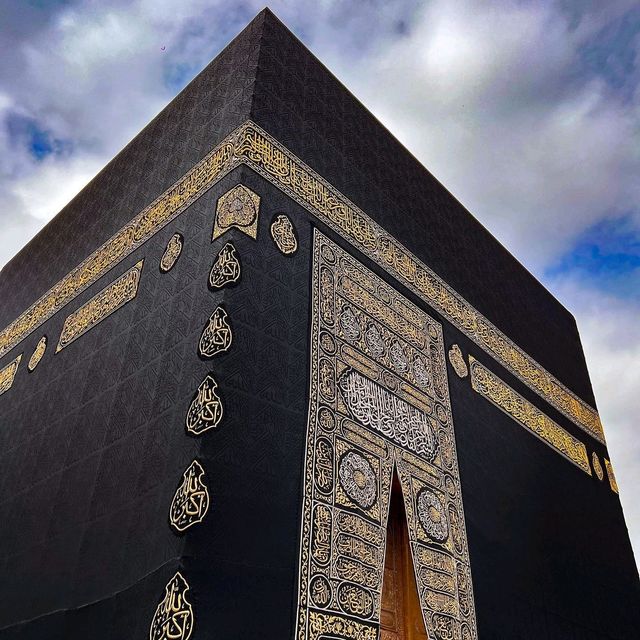
Discover the Kaaba, the holiest site in Islam located within Masjid al-Haram in Mecca, Saudi Arabia. Learn its history, spiritual significance, and cultural details.
<h2>Overview</h2><p>The Kaaba, a cubic structure draped in a black silk cloth, stands as the most sacred site in Islam, nestled within the sprawling Masjid al-Haram in Mecca, Saudi Arabia. It serves as the spiritual heart for over a billion Muslims worldwide, dictating the direction of their five daily prayers, known as the Qibla. This revered structure is not merely a building; it is considered the 'House of God' (Baytullah) and represents a focal point of unity and devotion for believers across the globe. Millions undertake the annual Hajj pilgrimage and the lesser Umrah pilgrimage, performing the ritual circumambulation, or Tawaf, around it.</p><h2>History & Cultural Background</h2><p>The origins of the Kaaba are steeped in ancient tradition, predating Islam. Islamic belief holds that the Kaaba was first built by angels, or by Prophet Adam, and later rebuilt by Prophet Ibrahim (Abraham) and his son, Prophet Ismail (Ishmael), as a house of worship dedicated to the One God. Historically, before the advent of Islam, the Kaaba was a polytheistic sanctuary, housing idols of various deities and attracting pilgrims from throughout the Arabian Peninsula.</p><p>A pivotal moment in its history occurred around 600 CE when Prophet Muhammad participated in its reconstruction after it was damaged by fire and floods. Following the conquest of Mecca, Prophet Muhammad cleansed the Kaaba of its idols, rededicating it to the sole worship of Allah, thus restoring its original monotheistic purpose. The structure has undergone numerous renovations and reconstructions throughout the centuries due to natural disasters and conflicts, each time reinforcing its significance.</p><h2>What Makes It Special</h2><p>The Kaaba's profound significance lies in its role as the Qibla, the fixed point towards which Muslims orient themselves during prayer, fostering a sense of global unity. It is the central element of the Hajj and Umrah pilgrimages, where pilgrims perform the Tawaf, circling the Kaaba seven times counter-clockwise.</p><p>Embedded in its eastern corner is the revered Black Stone (Al-Hajar al-Aswad), believed by Muslims to have descended from Paradise and to have been placed there by Ibrahim and Ismail. Another significant site nearby is Maqam Ibrahim, or the Station of Abraham, which is believed to bear the footprints of Prophet Ibrahim from when he stood to build the upper parts of the Kaaba. The Kaaba itself, though a physical structure, is understood as a metaphorical representation of God's house, symbolizing divine presence and universal submission.</p><h2>Stories, Fun Facts & Local Details</h2><p>One fascinating detail is that the Kaaba has not always been the perfect cube shape seen today. Its original dimensions, established by Prophet Ibrahim, included a semi-circular area known as Hijr Ismail, which was later excluded from the main cubic structure during a rebuilding by the Quraysh tribe due to financial constraints. The Kaaba used to have two doors and a window, unlike its current single door.</p><p>Historically, Mecca's valley location meant the area around the Kaaba was prone to flooding. There are accounts of pilgrims literally swimming around the Kaaba to perform Tawaf during such times, a sight unlikely to be witnessed today due to modern flood prevention measures. The black cloth covering the Kaaba, known as the Kiswa, is replaced annually in a ceremonial event. Interestingly, the tradition of covering it in black began during the Abbasid era; before that, it was covered in various colors like red, green, and white. The keys to the Kaaba have been traditionally held by the Al-Shaibi family for centuries, a lineage traced back to the time of Prophet Muhammad. There's a popular belief that planes and birds cannot fly directly over the Kaaba due to high magnetic forces, which is often cited as a reason for Mecca not having an airport.</p><h2>Visitor Perspective</h2><p>For pilgrims, the first sight of the Kaaba is often described as an overwhelmingly emotional and profound experience, evoking feelings of awe, gratitude, and humility. The atmosphere around the Kaaba is one of deep reverence and unity, with millions of diverse individuals performing rituals in harmony. The Tawaf, the act of circumambulating the Kaaba, is a deeply spiritual practice, connecting pilgrims to centuries of faith. Visitors are encouraged to dress modestly, covering arms and legs, and to approach the site with utmost respect for its religious significance and cultural norms. Non-Muslims are generally not permitted to enter the holy city of Mecca itself. For those undertaking the journey, staying hydrated and well-rested is a practical tip to enhance the spiritual experience.</p>
Location
Coordinates: 39.82617, 21.4225
View on Google Maps