Interior Spiral Staircase and Elevator
Istanbul, Turkey

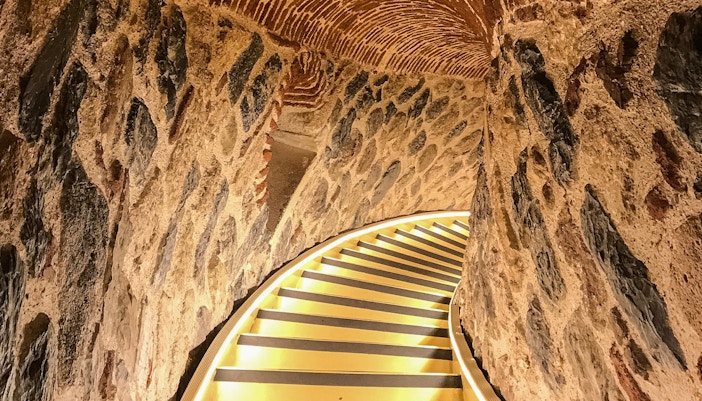
Explore the Galata Tower's interior in Istanbul, Turkey, featuring its historic spiral staircase, modern elevator, and captivating museum exhibits.
<h2>Overview</h2><p>Stepping inside Istanbul's iconic Galata Tower offers a journey through centuries of history, culture, and architectural evolution. This medieval stone tower, a prominent landmark in the Beyoğlu district, is not merely an external marvel but also boasts a captivating interior. Within its sturdy walls, visitors discover a blend of ancient construction and modern conveniences, most notably its internal spiral staircase and a discreet elevator. These elements collectively facilitate access to its upper reaches, culminating in a breathtaking 360-degree observation deck. The tower, which now functions as a museum, carefully preserves its historical essence while providing an accessible and engaging experience for curious travelers.</p><h2>History & Cultural Background</h2><p>The Galata Tower's story is deeply intertwined with Istanbul's rich past. While an earlier Byzantine tower stood on this site around 507-508 AD, the current structure was erected by the Genoese colony in 1348. Originally known as 'Christea Turris,' or the 'Tower of Christ,' it served as a vital watchtower and a key component of the Genoese fortifications protecting their trade settlement. Over the centuries, its purpose evolved dramatically. After the Ottoman conquest of Constantinople in 1453, the tower was repurposed, serving variously as a prison, a fire lookout point – particularly crucial for Istanbul's wooden cityscape – and later as an observatory. The tower has undergone numerous restorations, a testament to its enduring significance. Notable renovations occurred after earthquakes and fires, with significant changes made in 1794, 1832, and 1875. A pivotal restoration between 1965 and 1967 saw the replacement of the tower's wooden interior with a more robust concrete structure, and it was during this period that it was first opened to the public for tourism. Most recently, in 2020, the tower was meticulously restored once more and reopened as a museum, inviting visitors to delve into its storied past.</p><h2>What Makes It Special</h2><p>The interior spiral staircase and elevator of the Galata Tower offer a unique blend of historical authenticity and modern accessibility. The narrow, winding stone staircase, particularly evident in the lower sections, provides a tangible connection to the tower's Genoese origins. These thick, ancient stone walls and their characteristic rough-hewn appearance are a highlight for those who appreciate medieval architecture. Complementing this historical path is the modern elevator, which significantly eases the ascent for visitors, transporting them most of the way up to the tower's upper levels. This thoughtful combination allows for a broader range of visitors to experience the tower's grandeur. Beyond mere function, the interior now houses engaging exhibition areas with interactive displays, dioramas, and artifacts that narrate Istanbul's rich history, from the Byzantine era through the Ottoman period to modern-day Turkey. The unique fusion of these elements – the ancient stonework, the contemporary exhibits, and the dual ascent options – ensures that the journey to the top is as enriching as the panoramic vistas that await.</p><h2>Stories, Fun Facts & Local Details</h2><p>Beyond its architectural features, the Galata Tower's interior is steeped in fascinating tales and historical tidbits. Perhaps the most famous legend associated with the tower concerns Hezarfen Ahmed Çelebi, an Ottoman aviator who, in the 17th century, purportedly strapped on artificial wings and glided from the tower across the Bosphorus to the Asian side of Istanbul. While its historical accuracy is debated, this daring feat captures the imagination and speaks to the tower's iconic status. Another interesting fact is that the tower's massive walls are an impressive 3.75 meters thick at the base, tapering as they ascend, a testament to medieval engineering designed for structural stability and defense. The conical roof, a defining feature of its silhouette, was actually destroyed by a storm in 1875 and later meticulously reconstructed during the 1965-1967 restoration, restoring its familiar appearance. Furthermore, the Galata Tower was included in the UNESCO World Heritage Temporary List in 2013, recognizing its profound cultural and historical importance to both Istanbul and the world.</p><h2>Visitor Perspective</h2><p>For visitors, the interior spiral staircase and elevator are key to experiencing the Galata Tower. The elevator efficiently carries guests up to the seventh floor, providing a comfortable and quicker journey upwards. From the seventh floor, a short climb of two additional flights of stairs is required to reach the circular observation deck, which offers unparalleled 360-degree views of Istanbul, encompassing the historic peninsula, the Golden Horn, and the Bosphorus Strait. While the elevator makes the tower largely accessible, those with limited mobility should be aware of these final stair sections and the potentially narrow passages within the tower. Navigating the internal areas also allows travelers to observe the tower's genuine Genoese stonework up close and to explore the museum's various exhibits, which include Ottoman calligraphy, historical maps, and modern art installations that blend seamlessly with the ancient structure. To enjoy a more tranquil visit and avoid peak crowds, especially during sunset hours, it is often recommended to visit early in the morning or on weekdays.</p>
Location
Coordinates: 28.9741556, 41.0256556
View on Google Maps