Great Ball Court
Cancún, Mexico

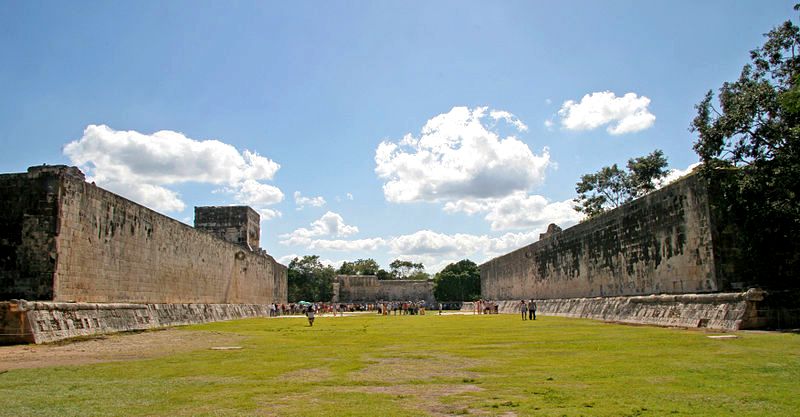
Explore the Great Ball Court at Chichén Itzá, Cancún, Mexico. Discover its ancient Maya history, ritualistic ballgame, unique acoustics, and cultural significance.
<h2>Overview</h2><p>Stepping onto the grounds of Chichén Itzá in Mexico's Yucatán Peninsula, one of the most commanding structures you'll encounter is the Great Ball Court. It stands as the largest and most well-preserved ancient ball court in all of Mesoamerica, an architectural marvel that continues to awe visitors with its sheer scale and the echoes of a profound past. This colossal arena, dedicated to the ancient Maya ballgame known as Pok-ta-Pok, served not merely as a playing field but as a vibrant stage for ritual, sport, and political spectacle in the heart of a flourishing ancient city.</p><p>Its imposing dimensions—measuring approximately 168 meters (551 feet) in length and 70 meters (230 feet) in width—immediately convey its importance. Unlike modern sports stadiums, this open-air court lacks a roof, allowing the azure sky to frame the towering walls, within which centuries of history and ceremonial significance are etched.</p><h2>History & Cultural Background</h2><p>The Great Ball Court, constructed around the 9th century CE, is a testament to the advanced architectural and cultural prowess of the ancient Maya people, blended with influences from the Itzá and Toltec cultures. The ballgame itself was far more than a simple sport; it was a deeply ritualistic event, symbolizing the cosmic struggle between light and darkness, life and death, and the perpetual cycle of the sun. The Maya believed that the game represented the movement of celestial bodies and played a crucial role in maintaining cosmic order.</p><p>According to the Popol Vuh, the sacred text of the K'iche' Maya, the ball court was a symbolic portal to the underworld. The architectural design of the court, often I-shaped, was believed to mirror the Maya cosmovision: the North Temple representing the heavens, the parallel walls the terrestrial world, and the playing field itself, lower than the rest, the underworld. This made the court a central site for significant ceremonies, legal trials, inaugurations of new rulers, and grand celebrations, showcasing socio-political power and divine knowledge.</p><h2>What Makes It Special</h2><p>Beyond its immense size, several features distinguish Chichén Itzá's Great Ball Court. High on the side walls, approximately 8 meters (26 feet) from the ground, are two intricately carved stone rings, adorned with feathered serpents. The objective of the game was to propel a heavy rubber ball through these rings, a feat requiring immense skill and precision, especially considering players could only use their hips, elbows, and knees.</p><p>The court's acoustics are legendary. A whisper uttered at one end can be clearly heard at the opposite end, over 135 meters away, regardless of wind direction or time of day. This remarkable architectural phenomenon, often referred to as a 'whispering gallery,' is a testament to the Maya's sophisticated understanding of sound and design. Archaeologists and even figures like conductor Leopold Stokowski have been fascinated by this acoustic marvel, though its exact scientific explanation remains a mystery.</p><p>The court is flanked by temples that further integrate its ceremonial purpose. At the north end stands the Temple of the Bearded Man, known for its detailed bas-relief carvings. On the eastern wall are the Temples of the Jaguar, featuring columns with descending serpents and a lower temple that once housed a jaguar throne. These structures provided elevated viewing platforms for priests, rulers, and nobility, underscoring the game's sacred and elite status.</p><h2>Stories, Fun Facts & Local Details</h2><p>The ballgame was played with a solid rubber ball, weighing between 3 to 5 kilograms (6 to 8 pounds), made from the latex of rubber trees. Carvings along the court walls vividly depict scenes from the game, including players in action and often, a darker, more dramatic outcome.</p><p>One of the most debated aspects surrounds human sacrifice. While some legends claim the winning captain was sacrificed—believed to be the ultimate honor, granting direct passage to heaven—others suggest it was the losing team, particularly its captain, who faced decapitation. Reliefs on the court walls graphically illustrate decapitated players with streams of blood transforming into wriggling snakes, symbolizing fertility and regeneration. This suggests that the outcome was often tied to divine will and had profound religious implications.</p><h2>Visitor Perspective</h2><p>Visiting the Great Ball Court is an immersive experience. As you walk its length, you can almost visualize the ancient spectacle, the thud of the rubber ball, and the chants of the spectators. Take a moment to test the extraordinary acoustics; a simple clap or soft whisper can resonate across the vast space, connecting you to the voices of the past. Observing the detailed carvings provides a powerful insight into the game's ritualistic significance and the worldview of the Maya. To fully appreciate its grandeur and the stories embedded within its stones, consider visiting during the cooler parts of the day, perhaps with a knowledgeable guide who can illuminate its many mysteries and historical nuances.</p>
Location
Coordinates: -88.5678, 20.6843
View on Google Maps