Galerie d’Apollon
Paris, France

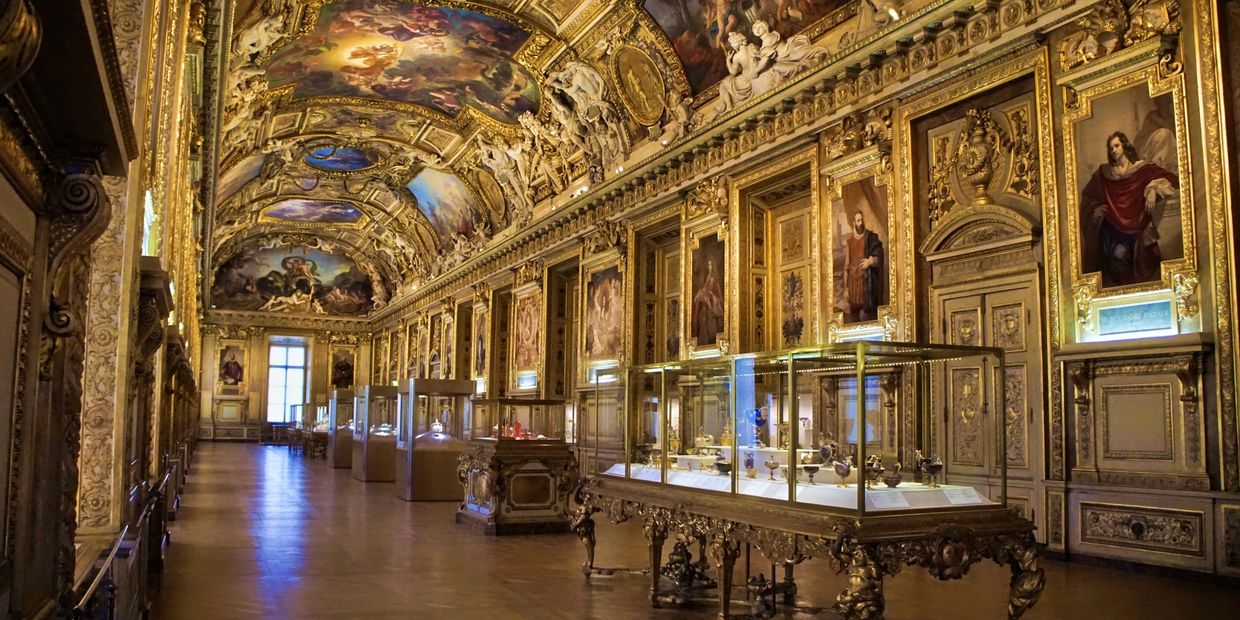
Discover the opulent Galerie d'Apollon in the Louvre Museum, Paris, France, home to the dazzling French Crown Jewels and stunning Baroque art.
<h2>Overview</h2><p>Nestled within the vast expanse of the Louvre Museum in Paris, France, the Galerie d’Apollon is a breathtaking testament to French royal grandeur and artistic ambition. This magnificent gallery, located on the first floor of the Petite Galerie wing, is far more than just a passage; it is a masterpiece of Baroque decoration and a precursor to one of the world's most famous royal spaces. Visitors step into a realm where gilded ceilings, elaborate frescoes, and precious jewels tell stories of kings and artists, offering a sensory journey through centuries of French history and culture. Today, it proudly houses a significant portion of the French Crown Jewels and an exquisite collection of hardstone vessels, making it a must-see for anyone seeking to understand the opulence of the French monarchy and the artistry of its era.</p><h2>History & Cultural Background</h2><p>The story of the Galerie d’Apollon is deeply intertwined with the ambition of King Louis XIV, often known as the Sun King. Its origins trace back to a devastating fire on February 6, 1661, which destroyed the former Petite Galerie. Louis XIV, then a young monarch, seized this opportunity to rebuild with unprecedented splendor. He commissioned architect Louis Le Vau to design the structure and entrusted Charles Le Brun, his First Painter, with the monumental task of its lavish decoration.</p><p>Le Brun's central theme for the gallery was the movement of the sun through the sky, directly glorifying Louis XIV, who closely identified himself with the Greek god Apollo, the god of the sun and arts. This thematic connection imbued the gallery with profound symbolic meaning, reflecting the king's power and influence over the universe. While Le Brun meticulously designed the ceiling with paintings depicting Apollo's journey from dawn to night, surrounded by a cosmos of related imagery like hours, seasons, and zodiac signs, the gallery's decoration was not fully completed in his lifetime or even during Louis XIV's reign.</p><p>The Galerie d'Apollon served as a critical aesthetic and architectural laboratory, directly influencing the design of the iconic Hall of Mirrors at the Palace of Versailles, built approximately two decades later. Its completion spanned nearly two centuries, with significant contributions from subsequent generations of artists and architects. Félix Duban directed its final embellishment in the mid-19th century, commissioning Eugène Delacroix to paint the central ceiling masterpiece, 'Apollo Slaying the Serpent Python,' a vibrant expression of French Romanticism.</p><h2>What Makes It Special</h2><p>What truly sets the Galerie d’Apollon apart is its exceptional Baroque artistry and its enduring historical legacy. It stands as the very first royal gallery in France, pioneering a style that would define an era. The sheer scale and meticulous detail of its decoration are awe-inspiring. Visitors are enveloped by gilded stuccoes, intricate carvings, and magnificent paintings that cover every surface, creating an immersive experience of royal luxury.</p><p>Beyond its architectural beauty, the gallery's distinction is magnified by the treasures it guards. Since 1887, it has been the permanent home of the French Crown Jewels, a dazzling collection that includes historic diamonds like the 'Regent,' 'Sancy,' and 'Hortensia,' and the 'Côte de Bretagne' spinel, among other spectacular pieces. These jewels narrate a compelling saga of French royalty, power, and historical upheaval. Additionally, the gallery showcases Louis XIV's remarkable collection of hardstone vessels, numbering around 800 pieces crafted from precious materials such as agate, amethyst, and lapis lazuli, reflecting the Sun King's passion for the arts and his desire to demonstrate French artistic supremacy.</p><h2>Stories, Fun Facts & Local Details</h2><p>Imagine the spectacle of court life that once unfolded here; the Galerie d’Apollon was initially envisioned as a grand reception hall, a space where Louis XIV could project his absolute power and divine right to rule. It's fascinating to consider that this opulent space, which took over 200 years to fully realize, laid the groundwork for the most famous room in Versailles. The 'Parquet de Versailles,' a distinctive diamond-shaped flooring pattern, is believed to have originated as an experimental design within this very gallery, making it a foundational element of French architectural history.</p><p>One notable gem among the Crown Jewels is the 'Regent' diamond, acquired by Philippe d’Orléans, who served as regent until Louis XV came of age. This immense diamond, weighing 140.64 carats after cutting, is renowned for its flawless brilliance and perfect cut. It has adorned the crowns of French kings, the sword of Napoleon I, and the diadem of Empress Eugénie, bearing witness to centuries of French political and social change. Each jewel tells a personal story of its royal owner and the tumultuous periods it survived, including thefts and sales throughout history.</p><h2>Visitor Perspective</h2><p>Experiencing the Galerie d’Apollon is akin to stepping into a grand historical painting. The moment you enter, the sheer brilliance of the gilded ceilings and the vastness of the space command attention, making it easy to understand why a 13-year-old Henry James, upon seeing it in 1856, described inhaling 'a general sense of glory.' While it might be tempting to rush to the celebrated French Crown Jewels, take a moment to look up. The intricate allegories on the vaulted ceiling, designed by Charles Le Brun and completed by artists like Delacroix, offer a profound narrative of Apollo's journey, which in turn symbolizes the glory of the Sun King.</p><p>Allow yourself to be captivated not just by the sparkle of diamonds but by the overall artistic unity and historical depth of the gallery. Observe the delicate craftsmanship of the hardstone vessels, each a miniature sculpture of vibrant mineral and metalwork. Though the gallery is sometimes subject to temporary closures for maintenance or special exhibitions, its fundamental role as a showcase of France's artistic and royal heritage remains constant. It's a space that encourages slow contemplation, revealing new details and stories with each glance, truly embodying the grandeur of French art and power within the heart of the Louvre.</p>
Location
Coordinates: 2.3376, 48.8606
View on Google Maps