Courtyard
Istanbul, Turkey

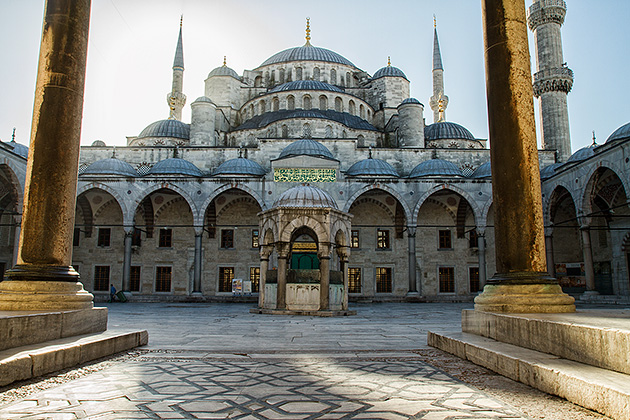
Explore the magnificent Courtyard of the Blue Mosque in Istanbul, Turkey. Discover its grand architecture, rich history, and cultural significance.
<h2>Overview</h2><p>The Courtyard of the Blue Mosque, officially known as the Sultan Ahmed Mosque, serves as a magnificent prelude to one of Istanbul's most iconic architectural wonders. Located in the historic Sultanahmet district, this expansive outdoor space is not merely an entrance but an integral component of the mosque's grandeur. Constructed between 1609 and 1617 under the ambitious Sultan Ahmed I, the mosque and its courtyard stand as a testament to classical Ottoman architecture. As large as the prayer hall itself, the courtyard is recognized as one of the biggest among all Ottoman mosques, immediately impressing visitors with its scale and serene beauty. It offers a breathtaking vantage point for appreciating the mosque's six soaring minarets and cascading domes, defining the Istanbul skyline and standing proudly opposite the revered Hagia Sophia.</p><h2>History & Cultural Background</h2><p>Sultan Ahmed I commissioned the mosque with a profound intent: to reinvigorate an empire facing political unrest and to construct a monument that would rival or even surpass the architectural splendor of the Hagia Sophia. This undertaking was unusual for its time, as the Sultan controversially utilized state funds rather than war spoils for its financing. The architect, Sedefkar Mehmed Agha, a student of the legendary Mimar Sinan, meticulously blended Ottoman and Byzantine architectural traditions, evident in the mosque's design.</p><p>Historically, courtyards in Ottoman mosque complexes, known as 'külliyes', were vibrant centers of community life. Beyond prayer, they served as important public gathering places where announcements were made and social interactions flourished. The Courtyard of the Blue Mosque continued this tradition, providing a vital space for the surrounding religious complex, which included a madrasa (theological school) and the tomb of Sultan Ahmed I himself, who wished to be buried beside his greatest creation.</p><h2>What Makes It Special</h2><p>The Courtyard's distinctive features contribute significantly to the Blue Mosque's overall splendor. Its sheer size is remarkable, creating a vast open area that allows for an unhindered view of the mosque's exterior from its base to the apex of its domes and minarets. The perimeter of the courtyard is encircled by a continuous vaulted arcade, or 'revak', adorned with numerous small domes, creating a harmonious and symmetrical enclosure. Three monumental entrances lead into this grand space, with the central entrance on the northwest being particularly impressive.</p><p>At the heart of the courtyard lies a hexagonal ablution fountain, or 'şadırvan', a traditional feature for ritual washing before prayers, symbolizing purification and spiritual readiness. The two minarets located at the outer corners of the courtyard, each featuring two balconies, frame the monumental structure of the prayer hall and complement the four other minarets that rise from the mosque itself, making a total of six. This thoughtful design creates a natural transition, preparing visitors for the sacred space within while allowing them to admire the architectural mastery from multiple perspectives.</p><h2>Stories, Fun Facts & Local Details</h2><p>One of the most enduring and charming tales associated with the Blue Mosque revolves around its six minarets. Legend has it that Sultan Ahmed I requested 'altın minareler' (golden minarets) from his architect. However, the architect misheard this as 'altı minareler' (six minarets), a number previously unique to the Ka'aba in Mecca, Islam's holiest site. To avert any perceived rivalry or presumption, the Sultan subsequently ordered a seventh minaret to be built at the Ka'aba. This story, whether fact or folklore, highlights the significance placed on the mosque's design and its relationship with other holy sites.</p><p>Another fascinating detail can be found at the western entrance to the courtyard, where a heavy iron chain hangs low. This chain was strategically placed to ensure that anyone, including the Sultan himself, who would enter the courtyard on horseback, had to lower their head in humility to pass underneath. This subtle architectural feature served as a constant reminder of the sanctity of the space and the equality of all before God, regardless of their earthly status. The courtyard itself, with its thoughtful design, offers a tranquil haven from the bustling city, allowing for quiet reflection.</p><h2>Visitor Perspective</h2><p>For visitors approaching the Blue Mosque, the Courtyard acts as the primary point of entry and observation. While the mosque remains an active place of worship, welcoming tourists outside of prayer times, it requires adherence to respectful customs. Visitors are generally guided through specific entrances, such as those on the south side, to manage foot traffic. Modest dress, including covered shoulders and knees for all, and a headscarf for women, is required, and shoes must be removed before entering the inner prayer hall.</p><p>The courtyard is a free access area, but be mindful of prayer times, typically occurring five times a day, during which tourist entry to the prayer hall is restricted. Early mornings or late afternoons are often recommended for a more serene experience, avoiding the largest crowds and allowing for peaceful appreciation of the architecture and atmosphere. Stepping into the courtyard is an immediate transition from the vibrant city into a realm of historical and spiritual calm, offering unparalleled photo opportunities and a profound sense of connection to Istanbul's rich past.</p>
Location
Coordinates: 28.9768, 41.0054
View on Google Maps