Chakri Maha Prasat Hall
Bangkok, Thailand

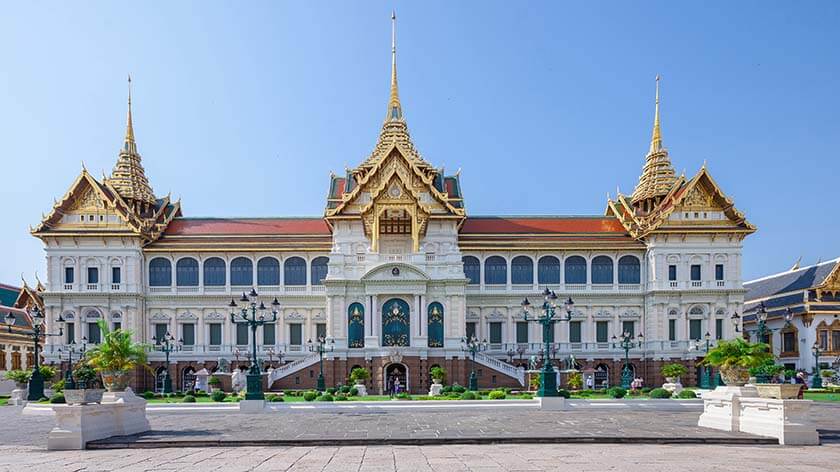
Explore Chakri Maha Prasat Hall, a stunning blend of Thai and European architecture within Bangkok's Grand Palace, Thailand.
<h2>Overview</h2><p>Nestled within the sprawling and sacred complex of the Grand Palace in Bangkok, Thailand, stands the magnificent Chakri Maha Prasat Hall. It is a central and visually striking structure, immediately recognizable by its unique architectural fusion. This grand throne hall, whose name translates to 'Great Palace of the Chakri', serves as a powerful symbol of the Thai monarchy's enduring legacy and its adaptability throughout history. As visitors approach, its distinct blend of European grandeur and traditional Thai elegance creates an impression that is both commanding and culturally rich, offering a glimpse into a pivotal era of the nation's development.</p><h2>History & Cultural Background</h2><p>The construction of Chakri Maha Prasat Hall began in 1876 and was completed in 1882, during the transformative reign of King Chulalongkorn, also known as King Rama V. This period marked a significant era of modernization for Siam (now Thailand), as the king sought to embrace Western advancements while preserving national identity. The hall was originally conceived by King Rama V to have an entirely European, specifically Italian Renaissance or neoclassical, design, envisioned with grand domes. However, members of his court, particularly his Chief Minister Chao Phraya Si Suriyawongse (Chuang Bunnag), strongly advocated for the inclusion of traditional Siamese architectural elements. This led to a compromise where the European-style base of the building was topped with traditional Thai gilded spires and a distinctive Thai roof, reflecting a deliberate effort to blend both influences. This decision profoundly shaped the hall's appearance, making it a physical representation of Thailand's careful navigation between tradition and modernity.</p><h2>What Makes It Special</h2><p>Chakri Maha Prasat Hall stands out due to its captivating 'eclectic style,' a harmonious yet deliberate blend of 19th-century European and traditional Thai architectural traditions. Its European lower sections, often described as Italian Renaissance or neoclassical, feature stately facades and intricate detailing, while its upper portions boast three traditional Thai prang (spires) and multi-tiered, colored roofs. This unique combination earned it the famous nickname 'the Westerner with a Thai hat' or 'the foreigner wearing a crown' among locals, a playful yet apt description of its hybrid nature. Beyond its architectural uniqueness, the hall holds significant royal importance. It was designed to serve as a royal residence, a throne hall, and a venue for receiving foreign dignitaries and conducting important state functions. While it no longer serves as a permanent royal residence, it continues to be used for ceremonial purposes, hosting significant events such as royal ceremonies and state receptions, further cementing its role as a living monument to the Thai monarchy.</p><h2>Stories, Fun Facts & Local Details</h2><p>The story behind the hall's design is a fascinating anecdote that highlights the cultural dialogues of King Rama V's era. King Chulalongkorn initially commissioned a British architect, John Clunich (sometimes referred to as John Blunich), for a purely European structure. However, court advisers, insistent on maintaining Thai identity in the kingdom's most important royal building, persuaded the king to incorporate traditional Thai roofs. This resulted in the distinctive silhouette we see today, a powerful statement of cultural synthesis. On the ground floor of the Chakri Maha Prasat, visitors can sometimes glimpse a collection of ancient weapons, displayed in the arcades along the building's front, though public access to this particular exhibit may vary and is often limited to weekdays. Furthermore, local lore suggests the hall is rumored to be haunted by the spirit of King Rama III, who is said to appear as a 'fat, dark-skinned man dressed only in a red chang kben,' adding a mysterious layer to its rich history.</p><h2>Visitor Perspective</h2><p>Visiting Chakri Maha Prasat Hall is an immersive experience into Thailand's royal heritage. Although the interior of the main throne hall is typically not open to the general public, its magnificent exterior and the surrounding grounds of the Grand Palace offer ample opportunities for admiration and photography. As you walk through the Middle Court, you'll witness the grandeur of its architecture and the meticulously maintained gardens. It is important for visitors to adhere to the strict dress code enforced throughout the Grand Palace complex, which requires modest attire, with shoulders and knees covered, as it remains a sacred and revered site for the Thai people. Planning your visit during the cooler morning hours is advisable for a more comfortable experience, allowing you to appreciate the intricate details and historical significance of this extraordinary building at a leisurely pace.</p>
Location
Coordinates: 100.49118, 13.7503
View on Google Maps