Central Prang
Bangkok, Thailand

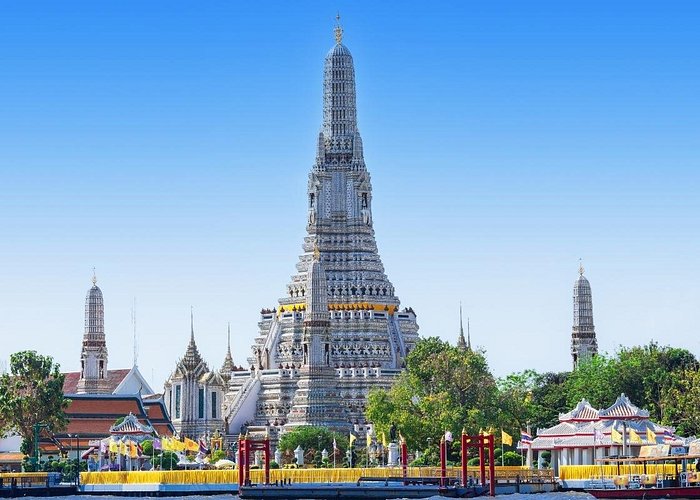
Discover the Central Prang of Wat Arun in Bangkok, Thailand – an iconic spire adorned with porcelain, rich in history, culture, and symbolism.
<h2>Overview</h2><p>The Central Prang, a majestic spire nestled within the sacred grounds of Wat Arun in Bangkok, Thailand, stands as an unmistakable symbol of Thai artistry and spiritual devotion. Dominating the western bank of the Chao Phraya River, this towering structure is the heart of the 'Temple of Dawn', famed for its breathtaking beauty, particularly as the first light of day illuminates its intricate surface. Standing between 66.8 meters and 86 meters high, the Central Prang showcases a distinctive blend of Khmer and Thai architectural styles, making it a unique landmark in the city's skyline.</p><p>Its surface, adorned with countless pieces of colorful porcelain and seashells, creates a dazzling, pearly iridescence that has captivated visitors for centuries. The main prang is encircled by four smaller satellite prangs, each contributing to the temple's grand and harmonious design.</p><h2>History & Cultural Background</h2><p>The history of Wat Arun, and by extension its Central Prang, stretches back to the Ayutthaya Kingdom, where it was originally known as Wat Makok. It gained significant prominence in the late 18th century when King Taksin established Thonburi as the new capital after the fall of Ayutthaya. Legend has it that he arrived at the temple site at dawn, inspiring its eventual name, 'Temple of Dawn', or 'Wat Chaeng'. For a brief period, the temple served as the royal chapel and housed the revered Emerald Buddha, before it was moved across the river to Wat Phra Kaew.</p><p>The iconic Central Prang we admire today largely owes its grandeur to King Rama II, who initiated its enlargement, and King Rama III, who oversaw its completion and elaborate decoration in the early 19th century. The name 'Wat Arun' itself is derived from the Hindu god Aruna, who is personified as the radiations of the rising sun, symbolizing new beginnings and spiritual awakening.</p><h2>What Makes It Special</h2><p>The Central Prang's allure lies in its intricate details and profound symbolism. Its Khmer-style architecture represents Mount Meru, the cosmic mountain considered the center of the universe in both Hindu and Buddhist cosmology. The four smaller prangs surrounding the main spire are often seen to represent the four cardinal directions and are sometimes associated with the wind god Phra Phai.</p><p>Perhaps the most striking feature is the ornamentation: the entire structure is meticulously encrusted with fragments of porcelain and seashells. These were not merely decorative elements but reportedly once served as ballast in boats traveling from China to Bangkok. This 'sacred upcycling' transformed mundane cargo into a shimmering, artistic masterpiece that reflects sunlight in a spectacular display of colors. The central prang is crowned with a seven-pronged trident, often referred to as the 'Trident of Shiva', further highlighting the blend of Hindu and Buddhist influences.</p><p>In Buddhist iconography, the prang's structure holds three symbolic levels: the base represents Traiphum (all realms of existence), the middle signifies Tavatimsa (the Tusita Heaven), and the top denotes Devaphum (six heavens of happiness).</p><h2>Stories, Fun Facts & Local Details</h2><p>The very nickname 'Temple of Dawn' stems from a historical account of King Taksin arriving at the site as dawn broke, viewing it as a auspicious sign for his new capital. Beyond its architectural grandeur, the Central Prang's decoration with thousands of recycled porcelain pieces tells a fascinating story of 19th-century trade and resourcefulness.</p><p>At the base of the prang, visitors can observe figures of ancient Chinese soldiers and animals, while higher up, statues of the Hindu god Indra riding on his three-headed elephant, Erawan, adorn the terraces. While ascending the steep stairs of the prang offers panoramic views of the Chao Phraya River and the city, it is considered by some to symbolize the challenges one must overcome to achieve enlightenment. Ringing the bells found within the temple complex is believed to bring good luck.</p><p>Wat Arun remains an active Buddhist temple, where monks reside and locals come to pray, especially during significant Thai holidays. The site has also become a popular location for cultural expression, with many visitors choosing to rent traditional Thai attire for photographs against its stunning backdrop.</p><h2>Visitor Perspective</h2><p>For those eager to experience the Central Prang, arriving early in the morning or late in the afternoon is often recommended. These times offer cooler temperatures, fewer crowds, and the most captivating light for photography, especially during sunrise when the temple truly lives up to its name, or at sunset when it's beautifully illuminated.</p><p>As an active religious site, visitors are kindly requested to dress modestly, ensuring shoulders and knees are covered as a sign of respect. Accessing Wat Arun is typically done via the Chao Phraya River, with frequent ferry services connecting it to other key attractions. Climbing a portion of the prang, despite its steep steps, rewards visitors with unparalleled views of Bangkok's historic riverside and offers a tangible connection to the temple's spiritual journey.</p>
Location
Coordinates: 100.48889, 13.74361
View on Google Maps