Central Archway
Antalya, Turkey

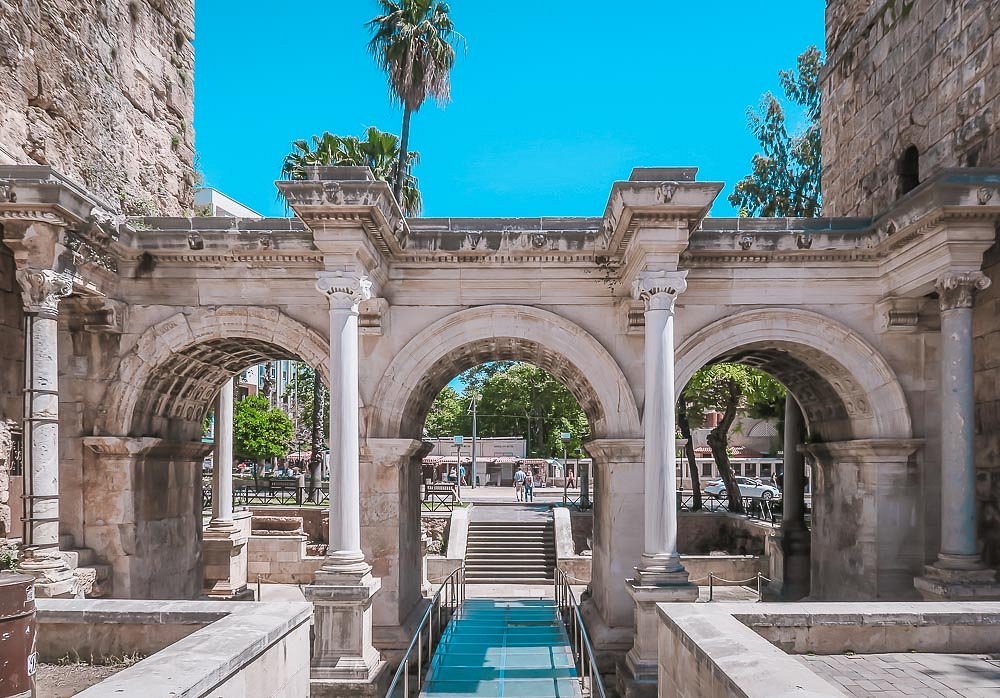
Discover Hadrian's Gate Central Archway in Antalya, Turkey. Explore this ancient Roman triumphal arch, its history, architecture, and cultural significance.
<h2>Overview</h2><p>Stepping through the Central Archway of Hadrian's Gate in Antalya, Turkey, is to traverse centuries in a single stride. This magnificent Roman triumphal arch, known locally as Üçkapılar or 'The Three Gates,' serves as a grand entrance to the historic old town, Kaleiçi. While 'Central Archway' specifically refers to the middle of the three identical arches, it is the collective structure that truly captivates. Each archway, standing at 4.15 meters wide and 6.18 meters high, contributes to the gate's impressive total height of over 8 meters from its ancient pavement. Built predominantly of gleaming white marble, with supporting granite columns, the gate showcases exquisite Roman artistry and stands as the sole surviving entrance gate from Antalya's original city walls. It is a portal connecting the bustling modern city with its richly layered past, inviting travelers to explore the wonders beyond its ancient threshold.</p><h2>History & Cultural Background</h2><p>Hadrian's Gate was erected in 130 CE, a monument dedicated to the visit of the Roman Emperor Hadrian to Attaleia, as Antalya was known in antiquity. This was a significant moment for the city, marking its importance within the Roman provincial framework. The gate was originally integrated into the formidable city walls that protected Attaleia, serving as a principal entry point. For centuries, the gate remained largely concealed by these surrounding walls, a circumstance that inadvertently contributed to its remarkable preservation. It was only in the 1950s, when parts of the city walls collapsed, that Hadrian's Gate was fully revealed to the modern world, leading to its comprehensive restoration in 1959 and 1961-62.</p><p>Architecturally, the gate is a prime example of a Roman triumphal arch, featuring two colonnaded facades. Its composite order capitals, blending the volutes of the Ionic with the acanthus leaves of the Corinthian style, speak to the sophistication of Roman design. An entablature, adorned with intricate floral motifs and ornate cornices featuring lion heads, caps the structure, adding to its grandeur. The barrel vaults of each archway are a sight to behold, decorated with caissons, each boasting distinct floral patterns and rosettes.</p><h2>What Makes It Special</h2><p>Beyond its sheer age and architectural beauty, the Central Archway, and indeed the entire Hadrian's Gate, holds a unique distinction. It is considered by many to be Pamphylia's most beautiful gate, a region rich in Roman history. What truly sets it apart is the rare opportunity it offers to walk upon the original Roman-era pavement. Beneath the central arch, a transparent walkway protects sections of the ancient road, revealing deep, parallel grooves worn into the stone by countless cart wheels over nearly two millennia. These ruts are a tangible connection to the past, testifying to the constant flow of commerce and life that passed through this very arch.</p><p>The gate's survival, largely due to its long period of being enclosed within city walls, is another aspect that makes it special. While a second story, believed to have housed statues of Hadrian and his family, is no longer present, the existing structure provides an almost pristine glimpse into Roman monumental architecture. The flanking towers also add to its distinctiveness; the southern 'Julia Sancta' tower dates to the Roman era, likely independent of the gate's initial construction, while the northern tower bears the marks of a 13th-century Seljuk reconstruction, complete with an Old Turkish inscription in Arabic script. This blend of Roman and Seljuk influences highlights the layers of history that have shaped Antalya.</p><h2>Stories, Fun Facts & Local Details</h2><p>Among the captivating tales surrounding Hadrian's Gate is the legend of the Queen of Sheba, Sultana Belkis. Local folklore suggests she passed through these arches on her journey to Aspendos to meet King Solomon. While historical timelines place her well before the gate's construction, this enduring legend adds a mythical charm, weaving a vibrant thread of storytelling into its ancient stones. It speaks to the gate's deep integration into the cultural consciousness of Antalya.</p><p>A fascinating discovery during the gate's restoration in the 1950s was a set of bronze letters at its base. These letters were once part of an inscription honoring Emperor Hadrian. Today, these precious artifacts are dispersed among various museums and private collections worldwide, including institutions in Vienna, Berlin, and England. This scattering of its original dedication serves as a poignant reminder of the gate's long and complex journey through time.</p><h2>Visitor Perspective</h2><p>Today, the Central Archway of Hadrian's Gate acts as a magnetic entry point to Kaleiçi, Antalya's charming old town. As you walk beneath its soaring arches, you are not just entering a district but stepping into a different era. The sound of modern city life gives way to the atmospheric, cobblestone streets of Kaleiçi, with its historic Ottoman-era houses, boutique hotels, and quaint shops. The sensation of the original Roman pavement visible beneath the clear walkway is particularly evocative, providing a direct, tactile connection to the Roman citizens, merchants, and soldiers who once trod the same path. It's a place where history isn't just observed; it's experienced.</p><p>The gate's location on Atatürk Boulevard makes it easily accessible and a natural starting point for exploration. Whether arriving by foot from the city center or via the nostalgic tram, its presence is a striking contrast between ancient heritage and contemporary urbanity. Visiting during the evening offers a particularly enchanting experience, as the illuminated arches cast a warm glow, inviting reflection on the centuries of human history that have unfolded here. It is a monument that truly connects modern Antalya with its profound past, offering a meaningful journey for every curious traveler.</p>
Location
Coordinates: 30.708611, 36.885278
View on Google Maps