Apse Mosaic
Istanbul, Turkey

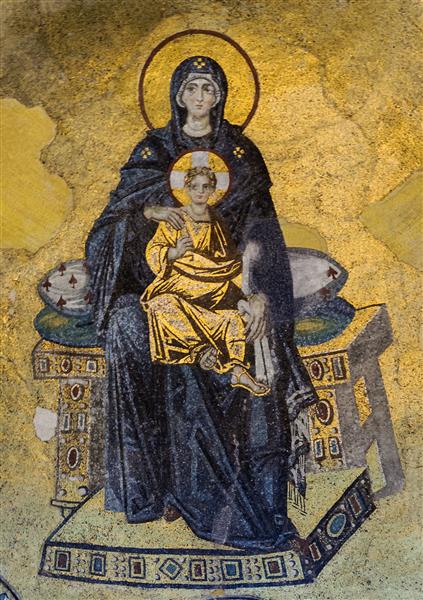
Discover the profound Apse Mosaic of the Virgin and Child in Hagia Sophia, Istanbul, Turkey. Explore its history, artistry, and cultural significance.
<h2>Overview</h2><p>High above the main altar, nestled within the semi-dome of the apse in Istanbul's majestic Hagia Sophia, lies a mosaic of profound historical and artistic significance: the Apse Mosaic of the Virgin and Child. This breathtaking depiction of the Virgin Mary, known as the Theotokos or 'God-bearer', enthroned with the infant Christ in her lap, immediately captivates visitors with its serene beauty and commanding presence. It stands as one of the oldest and most revered mosaics within the Hagia Sophia, offering a direct window into the Byzantine Empire's spiritual heart.</p><p>Its monumental scale and radiant gold background create an ethereal glow, drawing the eye upwards to this sacred imagery. More than just a decorative element, this mosaic is a powerful statement, embodying centuries of faith, political shifts, and artistic evolution within the former patriarchal cathedral, now a grand mosque. Its strategic placement in the holiest part of the church, directly above where the liturgy was once centered, underscores its immense importance to medieval worshippers and continues to inspire awe today.</p><h2>History & Cultural Background</h2><p>The creation of the Apse Mosaic is deeply rooted in a pivotal moment of Byzantine history: the end of Iconoclasm. This tumultuous period, spanning much of the 8th and early 9th centuries, saw the widespread prohibition, destruction, and covering of religious images throughout the Byzantine Empire. Following the official restoration of icon veneration in 843 CE, the Apse Mosaic was commissioned around 867 CE, marking the triumphant return of sacred imagery to the Great Church.</p><p>Its installation was not merely an artistic endeavor but a potent religious and political manifesto. Emperor Basil I, who reigned during its creation, intended it as a clear signal of the victory of Orthodoxy and a testament to his role as protector of the true faith. The mosaic carried an inscription, partially visible today, which boldly declared: 'The images which the impostors had cast down here pious emperors have again set up.' This statement directly referenced the preceding iconoclastic era, affirming the legitimacy of visual images in Christian worship and symbolizing the re-establishment of unity between God, the Empire, and its people.</p><h2>What Makes It Special</h2><p>What sets the Apse Mosaic apart is its seminal role in Byzantine art. It served as a prototype, inspiring countless depictions of the Theotokos enthroned with the infant Christ across the Byzantine world and beyond. The Virgin Mary is depicted seated on a backless golden throne, characteristic of Byzantine imperial power, with the Christ Child on her lap. Her right hand gently rests on his shoulder, while her left holds a small handkerchief. The Child, though miniature, is portrayed with a serious, knowing expression, a tiny Christ Pantocrator in appearance, raising one hand in blessing and holding a scroll in the other.</p><p>The artistry is exquisite, with Mary adorned in a cloak of deep blue and imperial purple, and both figures set against a radiant gold background. This masterful use of color and light, filtered through the apse windows, creates an almost ethereal halo around the figures, enhancing their sacred aura. The composition's simplicity, combined with its monumental scale, achieves a rare balance, making the image both intimately human and majestically divine.</p><h2>Stories, Fun Facts & Local Details</h2><p>One fascinating aspect of the Apse Mosaic is its unexpected survival through various historical transformations. When Constantinople fell to the Ottomans in 1453 and Hagia Sophia was converted into a mosque, many Christian mosaics were covered. Remarkably, the Apse Mosaic remained visible for approximately 300 years after the conquest. This unusual grace was likely due to the reverence accorded to Mary in Islam, where she is highly respected as the mother of Prophet Isa (Jesus).</p><p>It was only around 1750, amidst a period of heightened religious fundamentalism and external threats to the Ottoman Empire, that the mosaic was eventually covered with plaster. In the mid-19th century, during extensive restorations by the Swiss Fossati brothers, the mosaic was rediscovered. Recognizing its immense historical and artistic value, they meticulously documented it before carefully re-covering it, ensuring its preservation for future generations. Their respectful approach prevented its complete destruction and allowed its eventual reappearance.</p><h2>Visitor Perspective</h2><p>Visiting the Apse Mosaic today is an awe-inspiring experience that transcends time. As you step into the vast, echoing space of Hagia Sophia and gaze up at the semi-dome, the mosaic emerges as a beacon of artistic and spiritual endurance. Its serene image of the Virgin and Child, seemingly floating against a golden expanse, invites quiet contemplation, connecting you to the countless pilgrims, emperors, and worshippers who have stood in the same spot over more than a millennium.</p><p>The mosaic serves as a powerful reminder of Hagia Sophia's multifaceted history—from grand Byzantine cathedral to imperial Ottoman mosque and now back to a mosque—and the layers of culture and faith that have shaped this iconic structure. Standing before it, you can almost feel the weight of history, the triumph over iconoclasm, and the enduring artistic legacy of an empire. It's an intimate encounter with a masterpiece that continues to bridge civilizations and inspire reverence, making it an unforgettable highlight of any visit to Istanbul.</p>
Location
Coordinates: 28.980261, 41.008469
View on Google Maps